SAVING GRACE

In the autumn of 2003 we spent a few days at our cabin at Red Feather Lakes west of Fort Collins, Colorado. Our routine is to walk in the morning and evening around a choice of five different lakes that surround our cabin. The lakes are quiet in October as the ducks and Canada geese have begun to migrate and we speculate that most of the water fowl only migrate as far as Fort Collins where golf courses and city parks provide a temperate climate, lots of company and ample food on the nearby grain fields that are harvested in the fall.

On one particular day, we noticed a lone goose close to the shoreline of Lake Shagwa. As we drew close to her, we noticed her left wing was pointed skyward in an awkward position and we made a couple of assumptions: 1) Her mate was not with her (Canada geese mate for life) and may have perished in an attack that injured her or 2) her mate left her behind because her broken wing prevented her from flying.
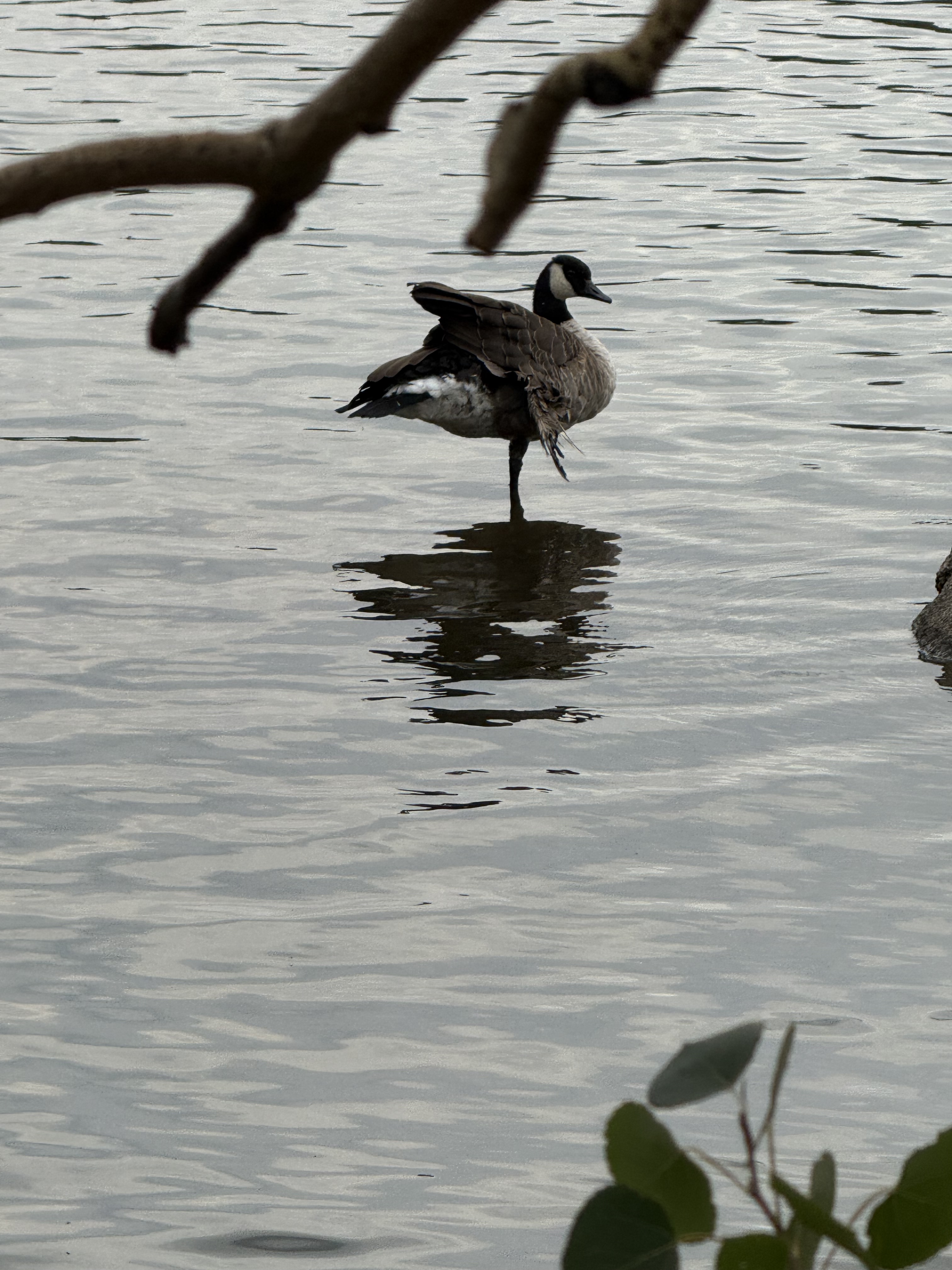
We watched her for a few minutes, and I took a photograph of her on my cell phone. We were saddened by her obvious dilemma, but had no idea how to help her. She could swim well enough and trying to catch her out in the water would be a fool’s errand. We moved on, silent in our thoughts as we tried to imagine what would become of her with winter coming.

In the spring of 2024 we made our routine visit to the cabin to open up for the summer season and began our ritual of walking each day around the lakes, which were still frozen over. Out in the center of Shagwa an aerator pumped, creating a circle of open water about eight feet in diameter. Shagwa is a shallow lake and oxygen is pumped from shore to create an opening to maintain an oxygen-rich environment for fish. Much to our surprise we could see a lone Canada goose with a distinctive handicap–her left wing pointed skyward–standing at the edge of the water. We marveled that she had survived the winter and it was clear the opening in the water, which would allow her to escape predators traveling over the ice, was her saving grace.

I photographed her several times throughout the summer and she seemed to be doing well in spite of being unable to fly. She was usually with a group of geese or ducks and spent time close to shore where it appeared they were being fed by passersby or some of the year-round residents in the cabins along the shore. We saw her paired with another goose and hoped she would find a mate for companionship.
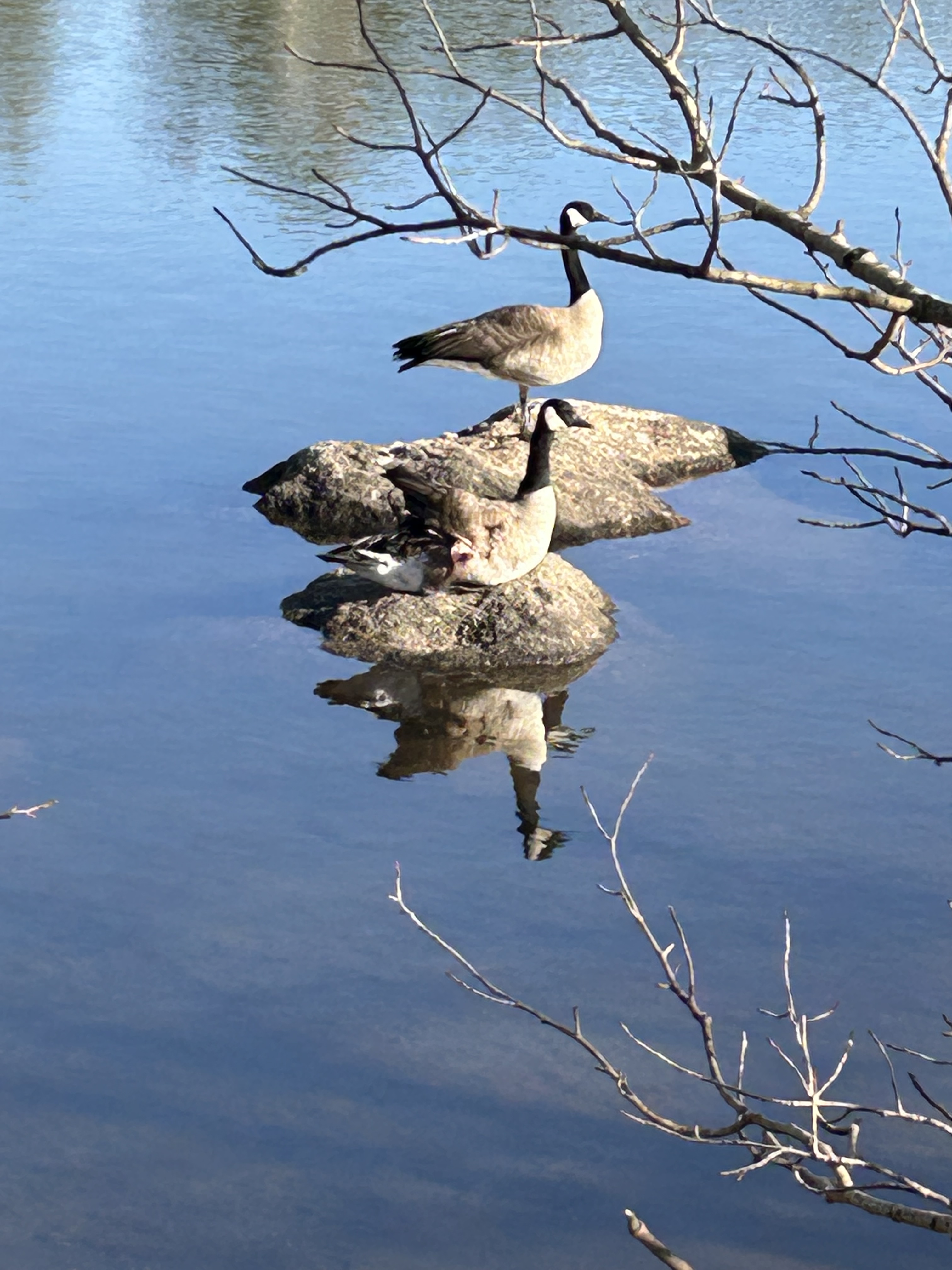
In January of 2025 we made an off-season trip to Red Feather Lakes to check up on things and have a post-holiday break. Roads were dry as there had been little snow and we took walks around the lakes as usual. When we came to Shagwa we were amazed to see a little hut erected out on the ice near the opening where the aerator created open water. I focused my camera’s distance lens on it and it appeared to be a large canvas dog carrier with a clear plastic window on two sides. And standing alongside it was Grace. She had protection from the bitter cold wind that Red Feather is famous for and it was close enough to water’s edge for her to escape any intrusion of coyotes, fox and other predators.
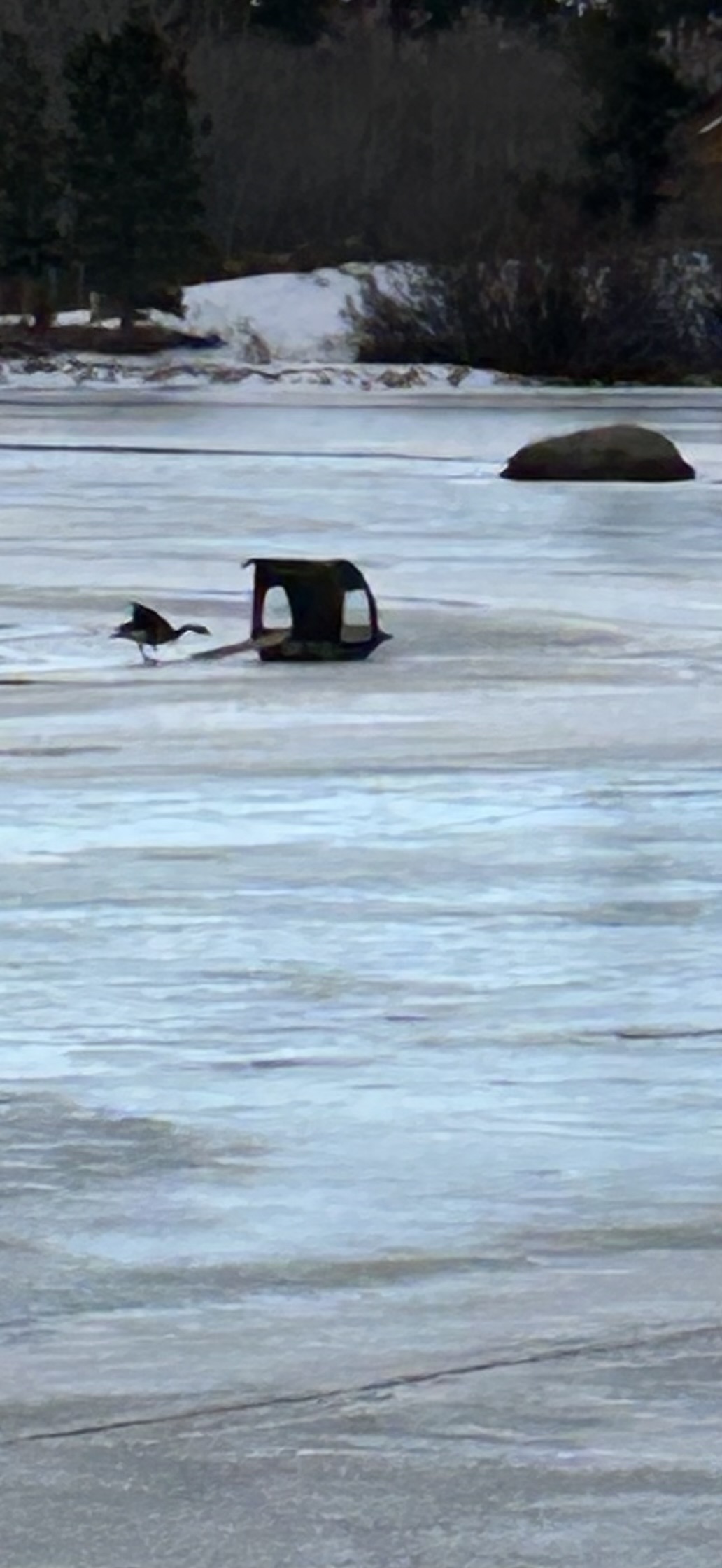
We were excited and grateful that someone cared enough for this stranded goose to offer her protection from the elements and food enough to stay alive. Later in the spring we happened upon an elderly woman feeding the ducks and geese along the shore. We spotted Grace and I remarked to the woman (who I will refer to as Grace’s caretaker} how amazed we were that she still survived and wondered who had braved the ice to plant the little hut. It was no mean feat, as whoever did it made certain the wind would not blow it away and got it secured by crawling over the ice to stake it firmly in place. By then it had been removed and ice on the lake had begun to break up. Where did it go?

The Caretaker

The ensuing conversation revealed the man who installed the hut had removed it when the ice melted and she heard he was moving away. She did not know how to contact him and speculated as we did whether he had passed the hut on to somebody else in case it was needed for another winter. My research has revealed that Canada geese can live to 30 years of age and it seemed like a long road ahead for Grace.

We are now approaching another autumn, Grace’s third as a captive of Shagwa, and it seems to us she has endured a great deal of uncertainty and risk. We ponder over her fate and wonder if her winter hut will miraculously reappear, if she will get enough to eat, if she will be strong enough to overcome the great odds she will face in another winter? Would it be possible to capture her, mend her broken wing and set her free once again? Some would say it would be best to euthanize her, but my heart breaks at the prospect of destroying a creature who has struggled to live her life as God intended.

Bridges on Dry Creek

“Dry Creek” aka Dry Fork of North Fork of Powder River

Spring brings snowmelt and rain which flows (and floods) down the old creek bed known as Dry Creek in central Johnson County. It is a misnomer to call it a “dry creek” as springs, seeps and standing water fill the channel, sometimes running underground into North Fork. Trying to negotiate this annual tide can be challenging.

Our walking path . . .

Once ice melts, we have to wear very tall boots or find another way around. Our daily walks are part of the routine, whether in rain, snow or shine. We also find it difficult to drive or operate equipment with a moat running through our property. Ducks, wild geese and birds love it, but the larger critters run into problems. Feedlot, our 1,000+ pound steer sinks into the mud and if he gets stuck, we have our hands full, literally.

Bridging the Gap . . . .

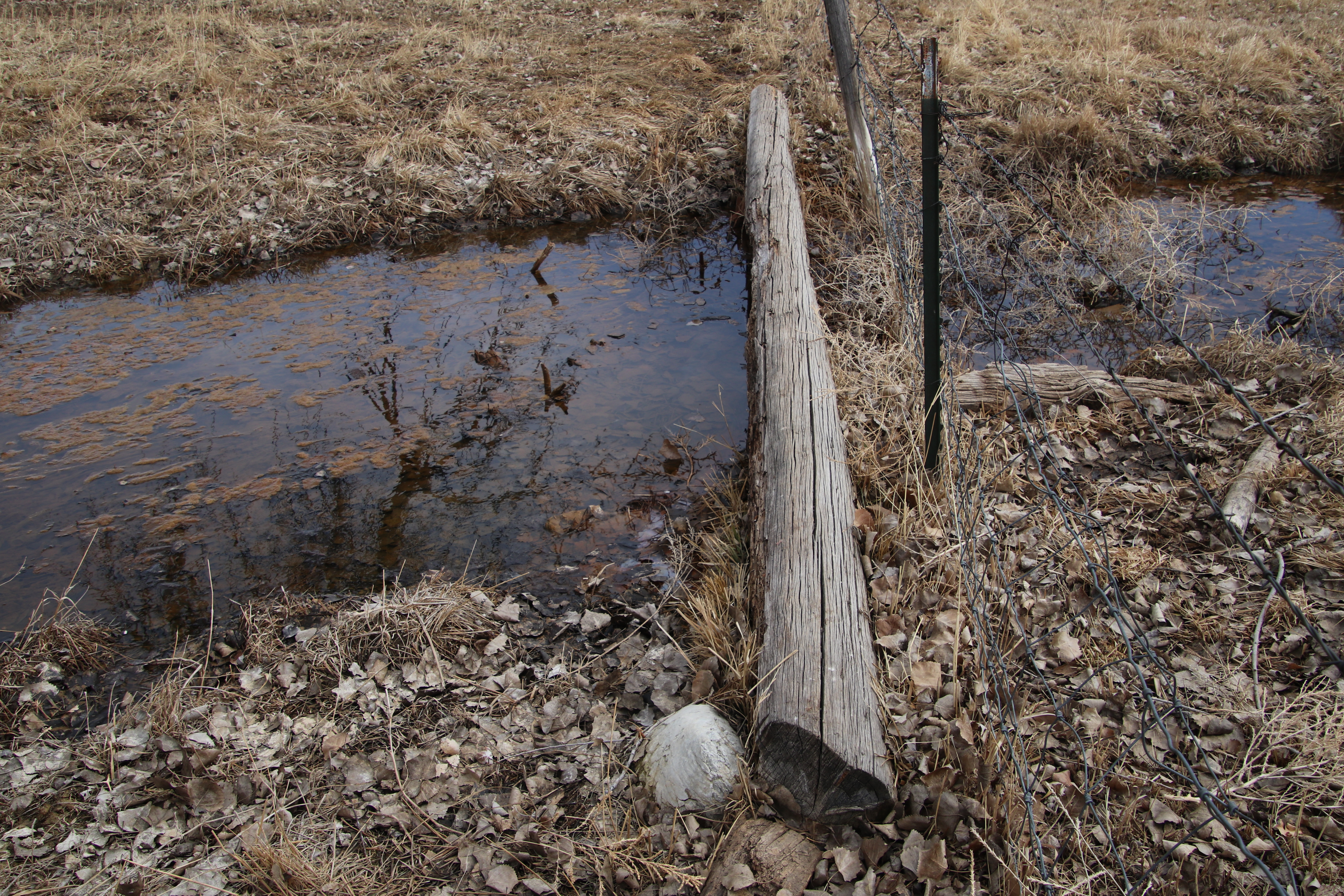
A pile of refuse (really?– on this place?) revealed a sturdy cast-off telephone pole, saved for some nebulous future use and when the creek dried up in September we drug it into place next to the fence. The water has come close, but has not run over this makeshift bridge, which I am determined to traverse each day without hanging onto the fence. Maud does it, I can do it, but Michael’s size 13 shoes just don’t want to hang on and he grabs the fence for balance.

Bridge Over Troubled Waters . . . .

In a wider, shallower section of the creek, we dumped rock in to make a bridge on the road leading to the lower pasture. The water matriculates through the stones and travels on its way down the creek. This crossing is pretty easy to negotiate until it freezes up and coats the rocks with ice.

Bridge to Nowhere . . . .

We installed a culvert just above the pond and filled in with dirt and rock to create a road across the creek. It is a rough ride, but we can drive across it most of the year. Right now it is pretty soggy and our steer leaves deep tracks in the mud. Water is backed up on both sides of the road and the culvert is completely submerged, but so far it has not run over the road.

A Bridge Too Far . . . .

These 16-ft. planed pine logs were part of the Nine Mile homestead cabin which was moved to the ranch headquarters in the late 1950’s. When we took the cabin down, we saved all the logs that were in good shape and used the rest in a variety of ways. These two are sturdy, even though they were milled over 100 years ago at the Mayoworth sawmill, and they make an excellent walking surface.

Crossing The Bridge . . . .

Frustrated that part of the walking path was submerged in water, I drug up some old corral poles and a long timber and anchored them on a downed tree trunk that protruded into the water. It was shaky, unreliable and dumped more than one traveler. Maud and I negotiated fairly well (you had to tip your toes down and lean a little to keep the long timber from teetering out from under you) but again, Michael’s size 13 shoes failed to make the journey. A few others with smaller shoes failed as well. Something had to be done!

Would you use this bridge? . . .

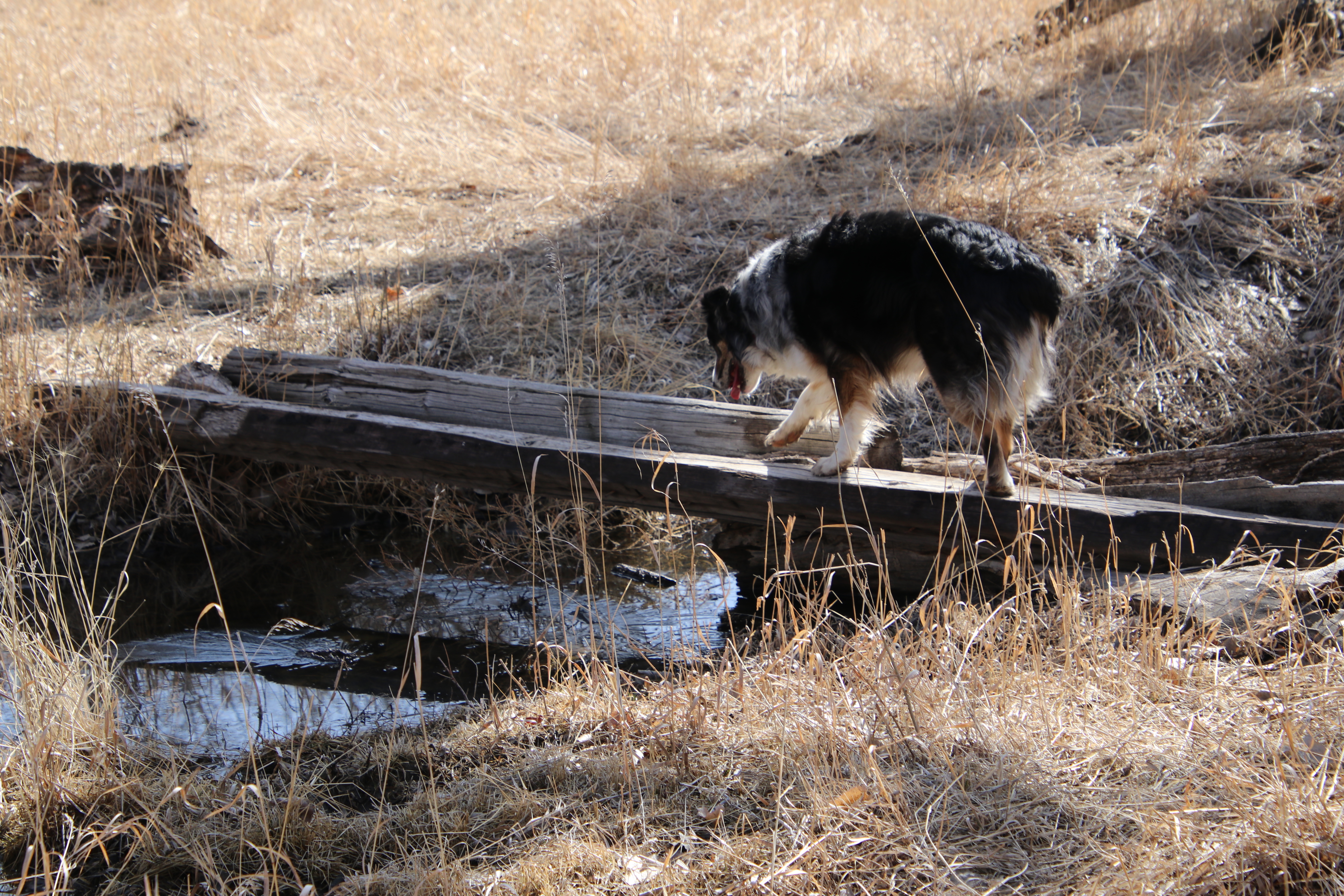
Previous mention of “refuse” needs an explanation. Dad and other area ranchers utilized oil field surplus of all kinds — pipe, sucker rod, pumps, scrap of all kinds, as well as wooden walking beams leftover from the days of wooden derricks in the Salt Creek field. Made of oak, they were meant to last a very long time. Two of the walking beams had migrated under the fence and out of sight until Michael asked for my help in hauling them down to the creek bottom.

A Bridge With Possibilities . . . .

We drug them from the barn yard down into the bottom and lined them out, taking measure to see if they were long enough to span the water in the creek. Amazing that they were sound after laying in the sun and wind for 40-odd years! Now the question looming large was “how do we get them across the creek?” Driving was out of the question – if we got the four-wheeler buried in mud, we would have to get the tractor to pull it out. Then we could get the tractor buried as well.

Love Can Build A Bridge . . . .

Michael had an idea we could move the beams with straps, which we have used successfully on many occasions, but this looked dubious. Somebody has to lead and somebody has to follow. Who is going to wade into the creek strapped to oak beams that weigh a ton?

Hoist upon a petard? . . .

At this stage of the operation, the camera crew (me) has to engage in the action at hand, which was quite complicated. We should have had a videographer! We began by sliding one of the beams in the water alongside my old, shaky bridge. Then I crossed to the other side and was able to reach the tip of the beam, dragging it out of the creek and up on the bank. With a strap, I was able to move my end up to the bridge site. Michael carried his end up to the site on the opposite side of the creek. He then shoved the second beam into the water, and I crossed to the other side to drag it up on the bank. Once we had them in place, we moved the long timber from my old bridge, laid it alongside the walking beams, wired the bundle together in a couple places and voila! A bridge that even Feed Lot can cross on (we have not witnessed him trying, but he has been as inconvenienced as we are with all our routes covered in water.)

Katya is our first customer . . .

In all, we have five crossings that are rude, crude and ugly but work to transport us across the water in “Dry Creek.”

TREES

Home to Great Horned Owls . . .

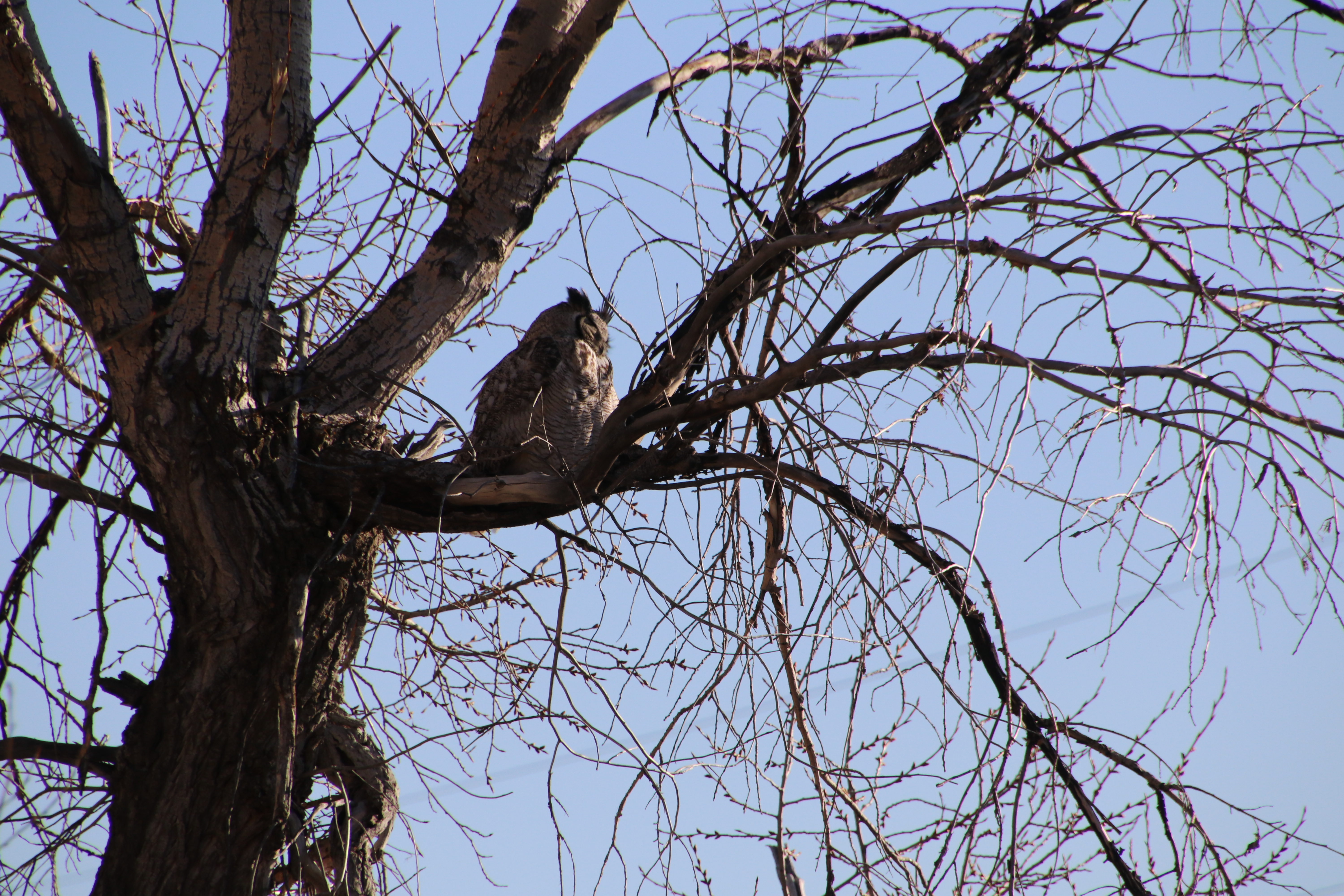
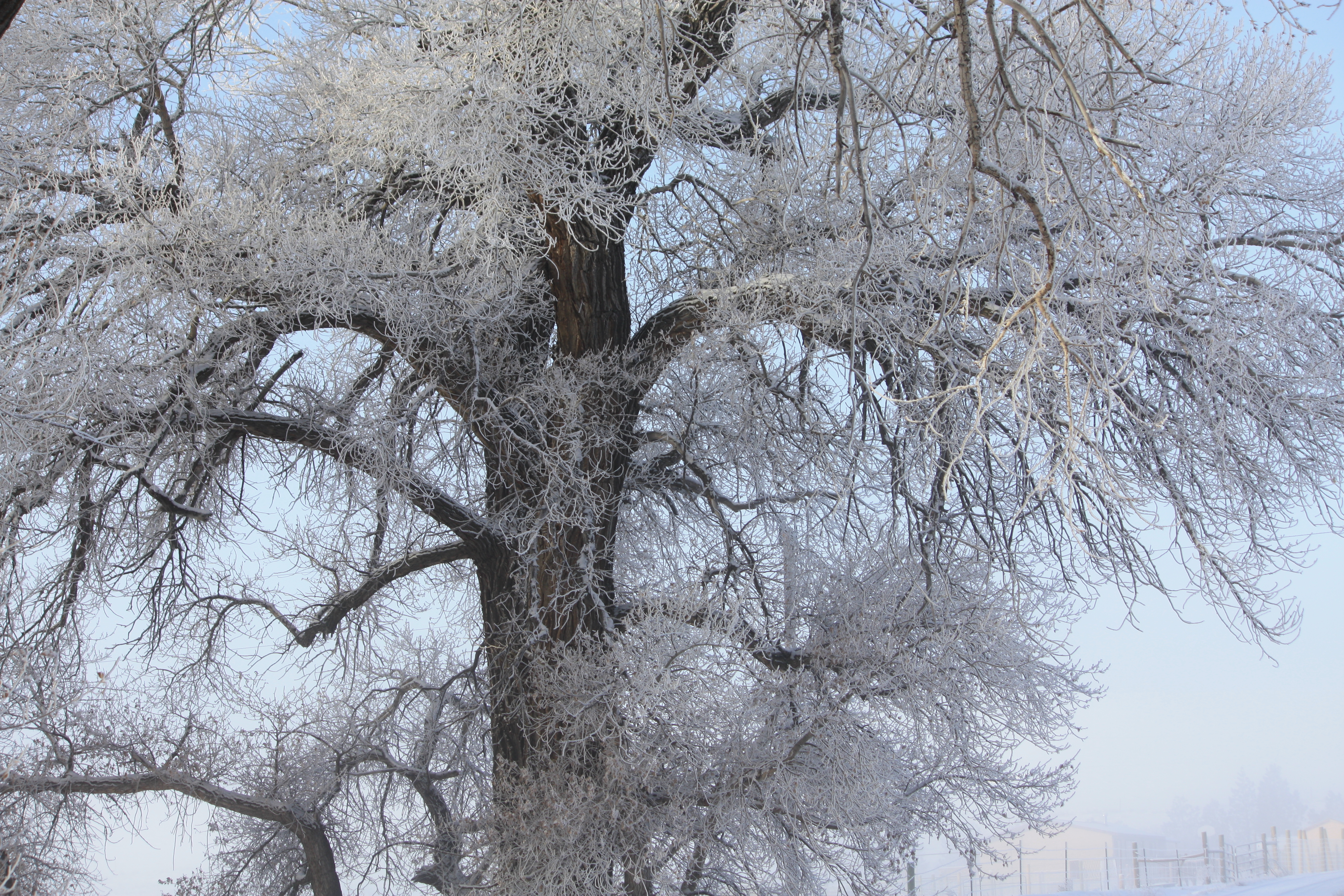
My earliest memories are of trees and I have been fortunate to surround myself with them wherever I lived. I selected apartments and houses to reside in that were as near to trees as I could manage, unwilling to live in barren places where I could not shelter under the leaves and limbs and shade of trees. The cottonwood tree pictured above is outside the windows of my childhood home here on Dry Creek. After a lifetime of living across the United States, coming home in 2003 was for me a return to my beloved trees.

Granny’s Lilacs . . .

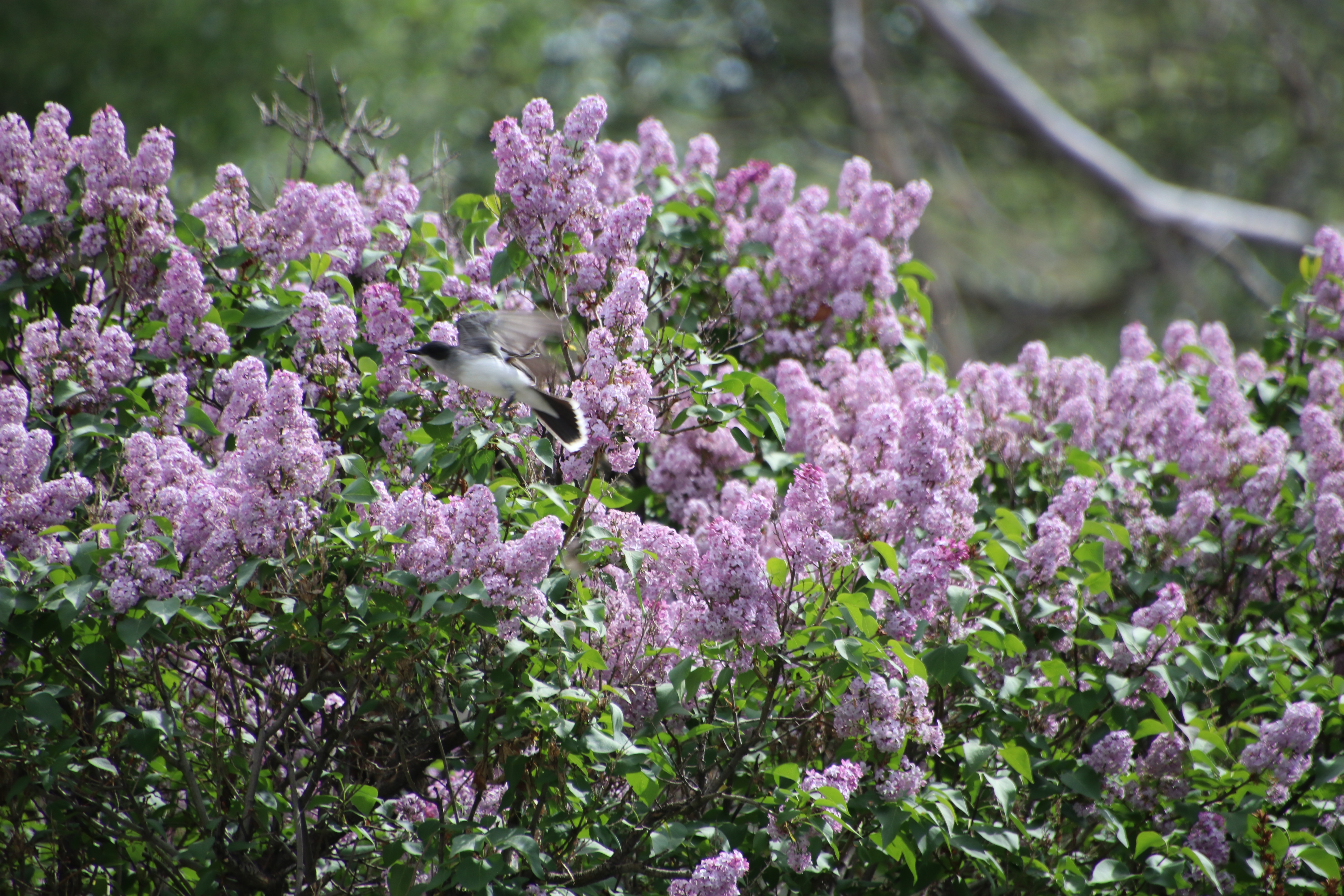
Ancient lilacs planted so long ago have endured and our memories are filled with them. When the family ranch headquarters was moved to Dry Creek in 1948, the lilacs were here.

Losing an old friend . . .

This giant elm, believed to be 100 years old, was likely planted when the first homestead was established here on Dry Creek circa 1920. Commonly referred to as “Chinese” elms, they are not native to Wyoming and were planted by early settlers. We grew up here with this old giant, and to finally have to bring it down was like killing a friend. It was becoming dangerous after shedding some huge limbs and causing quite a bit of damage and excitement. It was situated too close to our home and other structures and extensive trimming in recent years did not alleviate our fears. Interestingly, the firms we engaged to trim it stated they had never seen such a giant elm.

Cottonwoods in color . . .

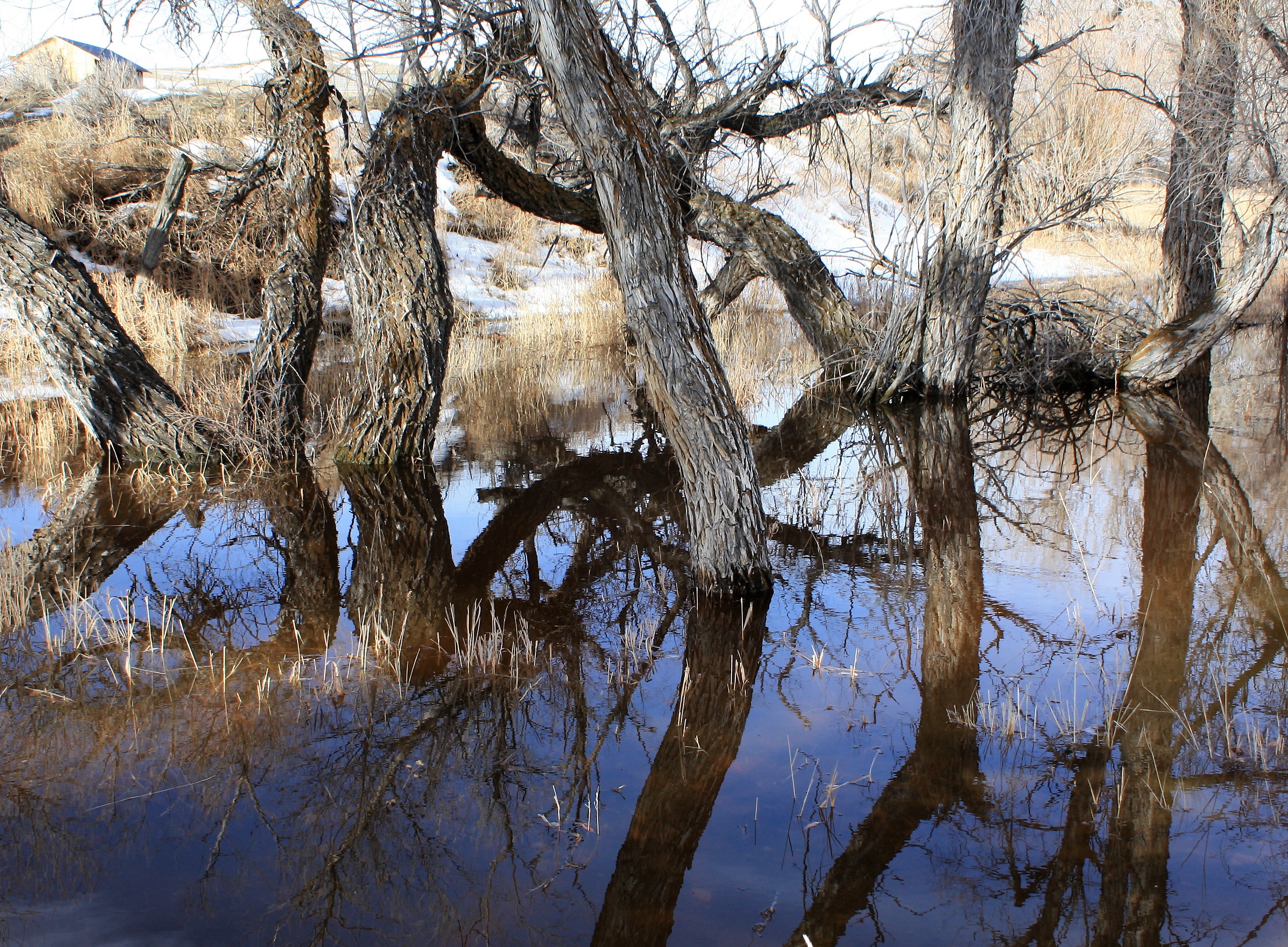
The view from below the pond captures some of the autumn color which stretches up and down the old creek bottom. Cottonwoods have grown along Dry Creek forever, sending their tap roots down to water in what we believe is an underground river that flows south to North Fork of the Powder River. Seeps and springs are present in many locations and the water runs in the early months of February through May, enhanced with snow melt and rain.

Willow dance . . .

Spring floods are common in February and March and the willows welcome the water. Unfortunately for the willows, the deer and cows love to eat the young saplings and many of the old growth have died out over a long period of time, unable to regenerate. We welcome the deer and occasional antelope that reside in the area. Very few domestic livestock have grazed the 15-acre tract we call home for the past 20-odd years and it is disheartening to see the loss of trees.

The daddy of them all . . .

This giant cottonwood towers over any tree for miles. I don’t believe I could bear to ever see it come down, so I have decided I have to go first. It sheltered me with a playhouse in its gnarled roots down along its base, and a childhood swing on a branch that finally fell gave me endless hours of joy pumping the wind to fly high.

New plains cottonwood . . .

I began to take stock last spring as I readied an order for new trees to plant and came up with some astonishing numbers. I divided the cottonwoods into three categories: 1) small -12 inches in diameter; 2) medium- 50 inches in diameter; and 3) BIG. My final tally down in the creek bed was 45 of the BIG cottonwoods; 82 medium sized cottonwoods; 138 small cottonwoods; indeterminate number of willows and 2 silver-leaf poplars. The cottonwoods are both narrow-leaf and plains, which are my favorite. Many more trees are planted around the house, in the orchard, at the barn, and along the entrance from the highway; Ponderosa pine, spruce, aspen, silver leaf poplar, elm, choke cherry, Canadian cherry, boxelder, cedar, lilac, caragana, willow, and a variety of bushes and shrubs.

Birds in heaven . . .

Of all the things that trees provide, perhaps my favorite is shelter for the birds. Living in a home with lots of windows and trees, I am blessed with a view of birds that change with the seasons. I try to document all the variety of birds that move through the area in migration and those who choose to stay for part of the year (see blog “Birds of Dry Creek.”)

Deadfall cleanup . . .

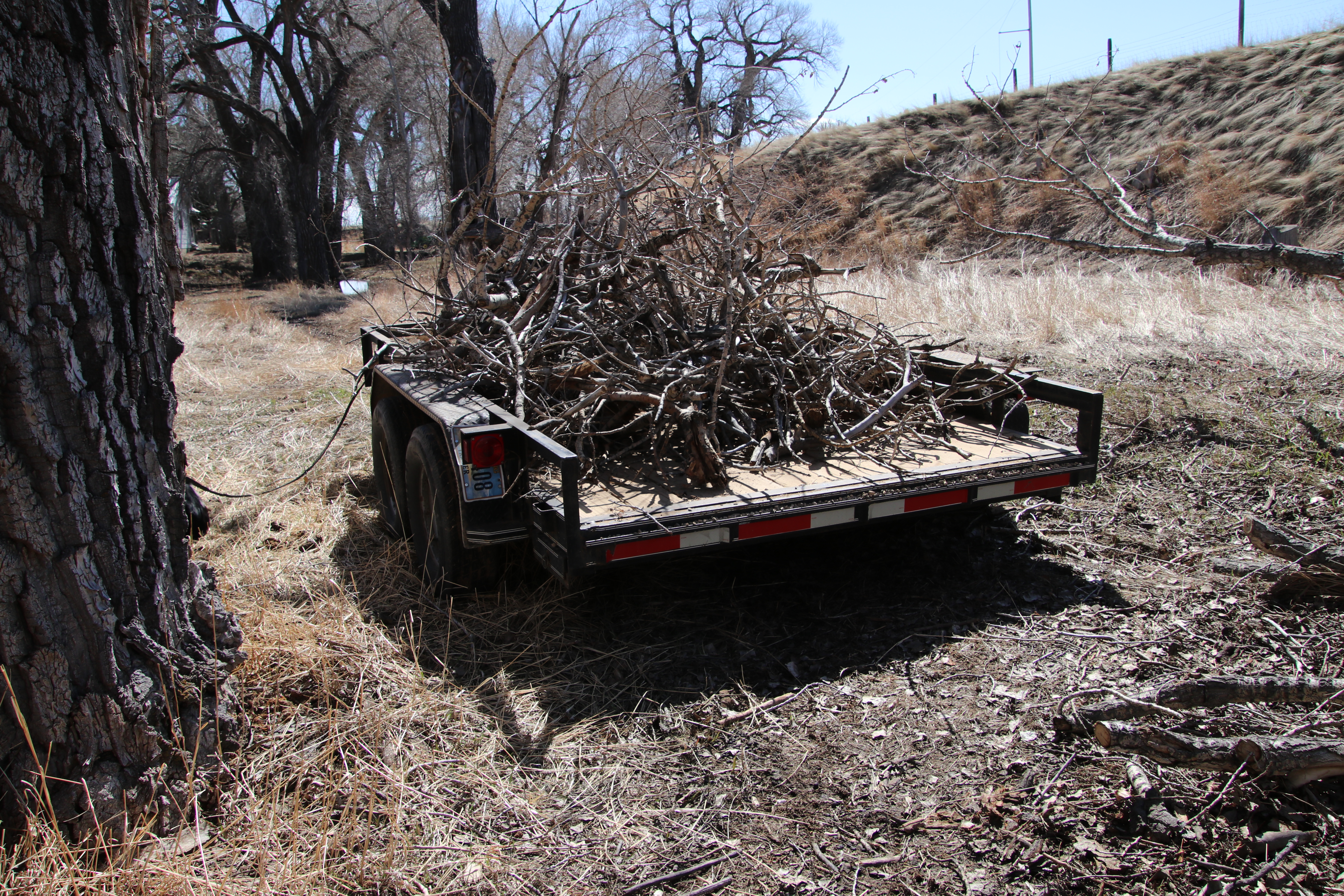
To live among trees, you must be willing to not only care for them but clean up after them (not unlike having a house full of children). Our daily walks include picking up branches and limbs the wind blows down with great regularity. In spring it is usually more intense and requires major cleanup, followed by a bonfire. We cut firewood from the larger trees that fall, split the logs and burn it in our fireplace in colder months.

Home is where the heart is . . .

Baby black birds are a recurring springtime event and I am thankful to the tree that shelters them each year. We have many bird houses, but it seems they are largely vacant. The birds love the trees and seek out their homes in hollows or build their nests in the branches, braving the elements to live high in the tree tops.

The road home . . .

Could not count the trips down this lane coming home from whatever far flung place I have traveled or resided in. For me, the sight of the old trees was like a warm embrace, welcoming me back. As I strive to save them and replace them with new trees, I feel I am saving a place that is sacred to me. Hopefully those who follow me will love the trees and all the creatures living within them.

Tilly and Abe

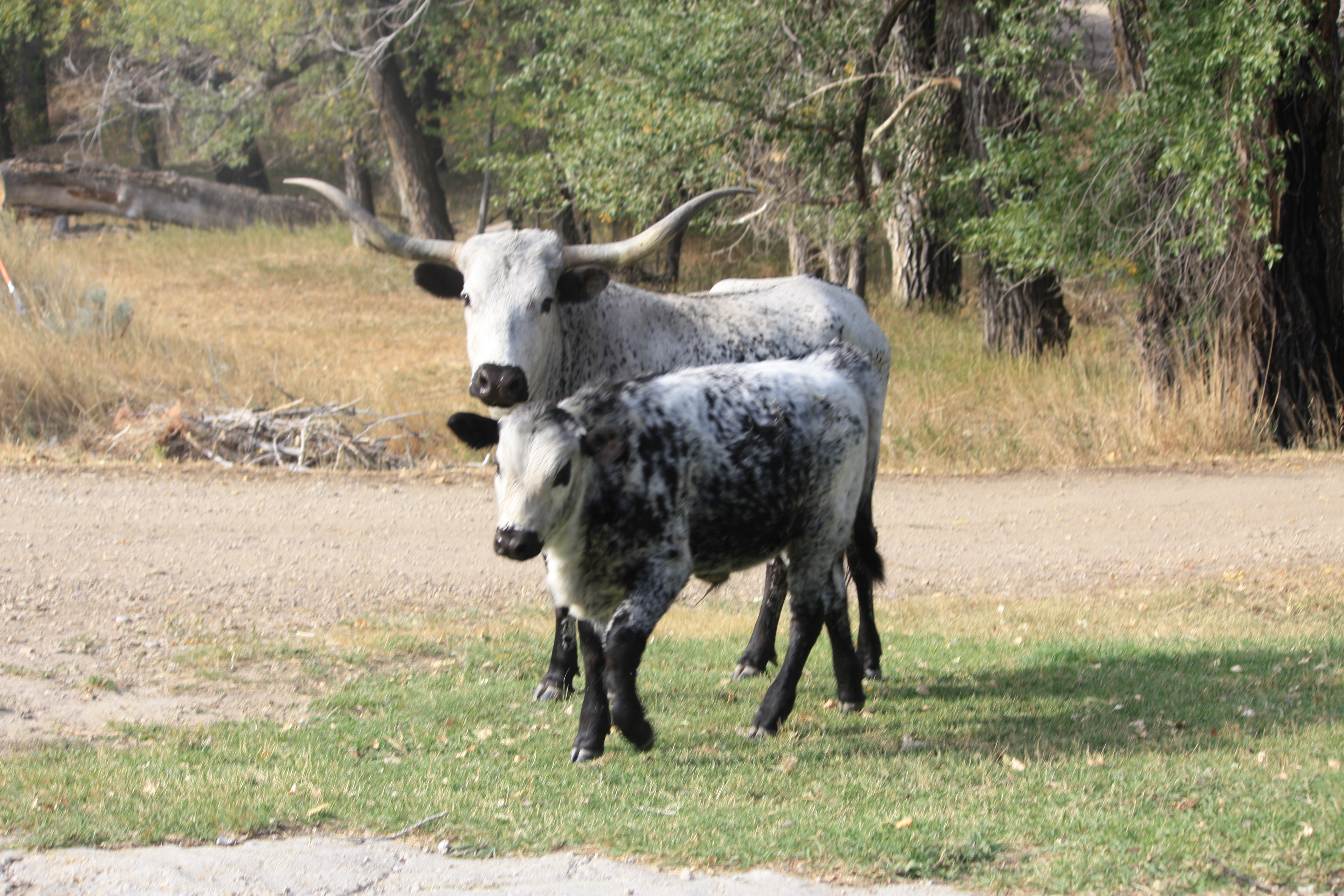
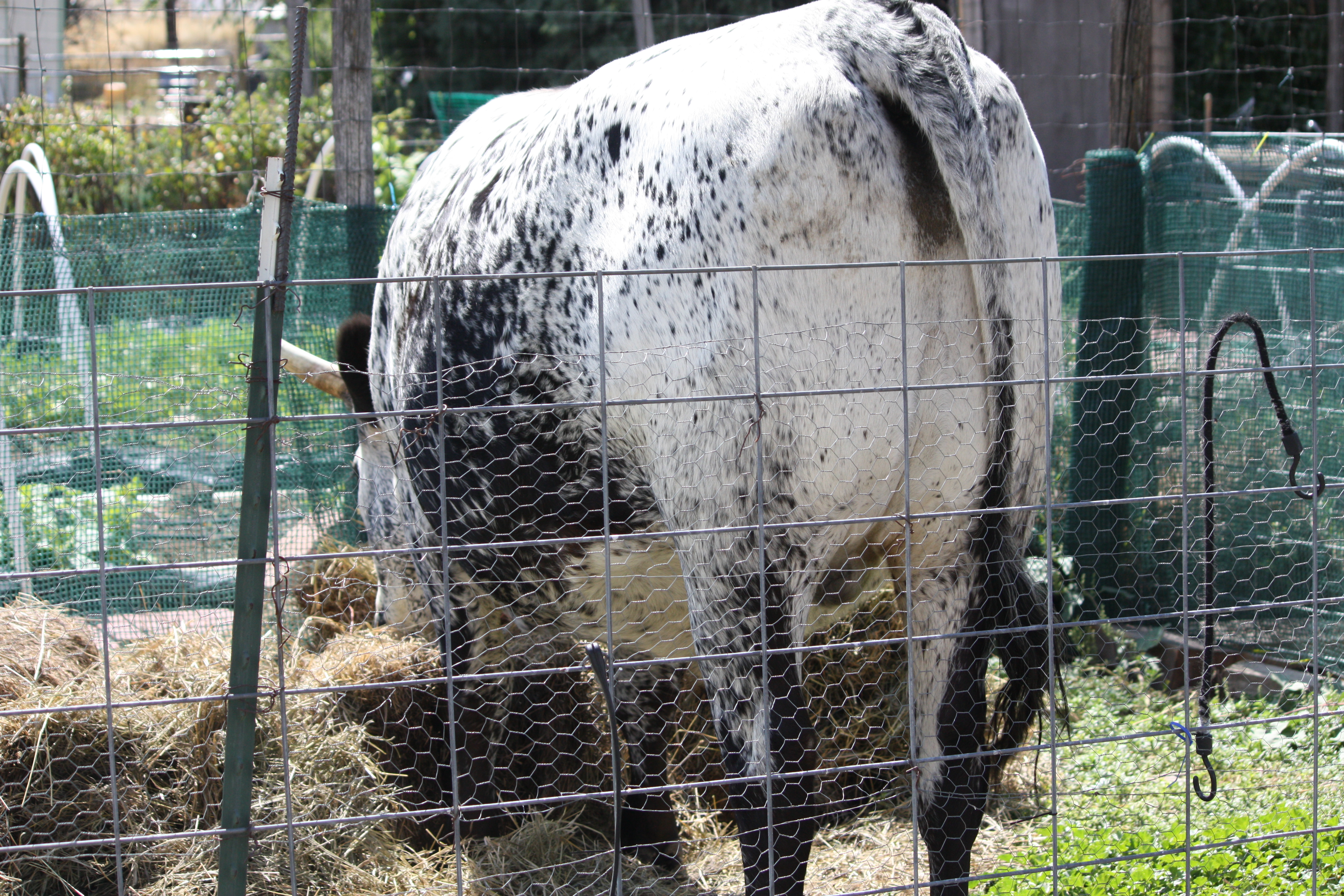
Our Longhorn/Angus steer who we fondly refer to as “Feedlot” will be turning 10 years of age soon, and it has been an interesting decade to say the least. We acquired him as a weanling at the same time we took delivery on a foal we had invested in and the two became bunkmates in a round pen. We figured they could keep each other company while they sorted out the loss of their mothers and maternal love.

A handsome lad . . .

Officiallly named Abraham, many other monikers took over, including Rib Eye, Meat Loaf and of course, Feedlot. I am probably missing a few as well as many epithets hurled his way as he found myriad ways to get into mischief.

In all his glory . . .

Feedlot’s curiosity about anything unusual or different in his range of vision requires him to investigate, test and terminate. Young trees, new fences, containers of all types, nothing misses his attention. Growing trees in Wyoming is one of the most difficult endeavors one can imagine,and trying to give them a real chance of survival means overcoming Feedlot’s determination to break branches, chomp leaves and strip the bark with his horns.

Invasion . . .

Caught in the act of invading a small chicken pen next to the garden, he contents himself with eating the remains of a bale of straw he dug out of the shed, broke open and scattered about. NIce going, Feedlot!

Mother’s Day gift 2012 . . .

Tru Tahlequah Miss arrived at Penrose, CO on Mother’s Day. We bred one of my niece Sue’s mares, a sorrel with enough splash to qualify as a registered paint to a handsome registered black and white paint, Sugs Tru Luck and our lives took on a whole new dimension.

Buddies . . .

My dog Rosie is curious about these new additions to the family. She is cautious around them but very interested in staying close. Feedlot stopped crying and wailing for his mama when Tilly arrived. After Tilly overcame her trauma of traveling from Colorado in a trailer, she seemed to be getting along reasonably well. With Tilly, I have learned you never know her real attitude until she unwinds in an explosion of bucking, kicking and stomping. She will be 10 on Mother’s Day, 2022 and it has been a decade of fun and fury.

“Not enough water for both of us!” . . .

Draining the bird bath was a minor nuisance from this pair. What one did not think of,the other did. And when they were apart, they were always on the lookout for each other. When Tilly had to go to the vet, Feedlot became agitated and would follow the horse trailer to the cattle guard. He was always on hand for her return to check in with her.

“Is this any way to treat me?” . . .

Feedlot does not have a “full rack” of horns that his Longhorn mother has. One horn grows up, the other down near his cheek. It became apparent something had to be done so a trip to the vet ended in a chunk being sawed off. It was a pretty gruesome experience and he is being bandaged to stop the bleeding. He was so happy to be home again and I am certain Tilly was sympathetic to his plight.

A friend in need . . .

When it came time to put Tilly under saddle, Feedlot was bad news. A maiden voyage with me on her back and my trainer leading her around the pasture created tension between Tilly and her possessive friend Feedlot. When we managed to elude him and traveled through a gate that contained him, he threw a fit, running along the fence snorting and raking his horns along the fence. When we drew out of sight, Tilly was agitated. At first she seemed to calm down, but shortly did what I have learned is her modus operandi. She bucked me off. Ord, my trainer took her back to the barn, while I trailed along with severe lower back pain. He took her out and made her follow the trail we had outlined for our ride. She gave him no trouble, but that was small comfort to me.

Girls just gotta have fun . . .

Tilly expresses irritation and frustration with loading in the horse trailer. It took quite a while and many rodeos to convince her.

“Let’s do lunch” . . .

A tree collapsed in a storm and we piled up branches for days to be burned. This pair could not contain their curiosity, checking to see if there were any remaining leaves to chew on. Typical of their behavior. We decided to build a fence to separate them and see if we could produce a foal to keep Tilly company. Plans to breed Tilly began in earnest and consumed two summers and a small fortune in vet fees and stud fees. To no avail. The vet reasoned that since she was an “old maid” she might be difficult. I question that assessment and am debating whether to try again. Perhaps if we found a real nice guy instead of doing artificial insemination, she would cooperate?

The face of an angel, soul of a devil . . .

Feedlot was thrilled this past autumn when we invited his mother for an extended visit to help graze the pastures along with a couple other cows. They nuzzled and loved on each other while Tilly had to just watch from afar. Hmmm. She needs a friend without horns!

Mama Longhorn looking for her baby . . .

Feedlot was Panda the Longhorn cow’s last calf and she lives next door where she can keep an eye on him. Their bond is truly heartwarming – a mother never forgets. It is almost as great a friendship as Tilly and Feedlot share.

A FOX IN THE HENHOUSE?

Hey, you pretty girl!

This black and white Brahma with feathered feet and legs was one of my favorites and I named her Henrietta. She was a giant of a hen, with a gentle disposition and the funniest running gait of the flock. According to my chicken reference book, the Brahma hails from the Brahmaputra region of India, although that has been disputed. Some argue that the Brahma was developed in the U.S. by crossing Cochin and the Malay breeds. Matters not to me.

When I went last evening to feed and gather eggs, I found her in a nesting box, dead. No trace of wounds or injury, although sharp teeth can penetrate leaving little observable damage behind in all the feathers. We looked for tracks in the snow and Michael believes he saw a trail most likely of a fox from the direction of the creek. It had to have approached in the late afternoon and the snow and cold kept most of the chickens inside the coop. Poor Henrietta, she just happened to have wandered out for a bit of fresh air and after being attacked, made it back inside and hopped up into a nesting box where she died.

The Gang of Eight, plus Ethel

All eight of these young chickens were chicks purchased in the spring of 2021. After spending their first few months in the brooder house together they continue to hang out apart from the older hens, which I find quite amusing. Henrietta in the foreground, will be missed by the gang. Mother Goose Ethel wants to supervise the group and adds her two cents worth. After encountering a contest between her and Rocky, the sneaky rooster in the background (an unplanned for male interloper) I am beginning to think he had something to do with Henrietta’s demise. Ethel won the challenge with him, for now, but if he persists in being cruel to the hens or to me, heaven forbid, he will face severe consequences.

In the spring, I will expand my order to three or four of the Brahmas to add to the flock.

Boundless Beauty

IMG_1230 (2)

Hazelton Peaks . . . .

There are many beautiful places in the Big Horn Mountains, but my favorite is the south end.  This view looks northwest, and the peaks in the background are beautiful, but the broad shoulders and high mountain plateaus with open prairie stretch before us in a grandeur that is only found in the south mountain range.

IMG_1231 (2)

Grazing paradise . . . .

A few Angus cattle graze below and what a pasture they enjoy!  In the early 1900’s more sheep than cattle could be found here and now it is a mixture of both.  This is private land, not national forest.  The ranchers that have grazed their livestock over the past 100 years have, for the most part,  been good stewards.  Earlier homesteads in the late 1800’s gradually evolved into larger parcels to provide a livelihood.

IMG_4994 (2)

Evening . . . .

As dusk approaches the light changes from golden to a muted color.  Rugged country, it seems empty to some who feel the need to be surrounded by settlement or ranch houses.

IMG_5007

Life on the range . . . .

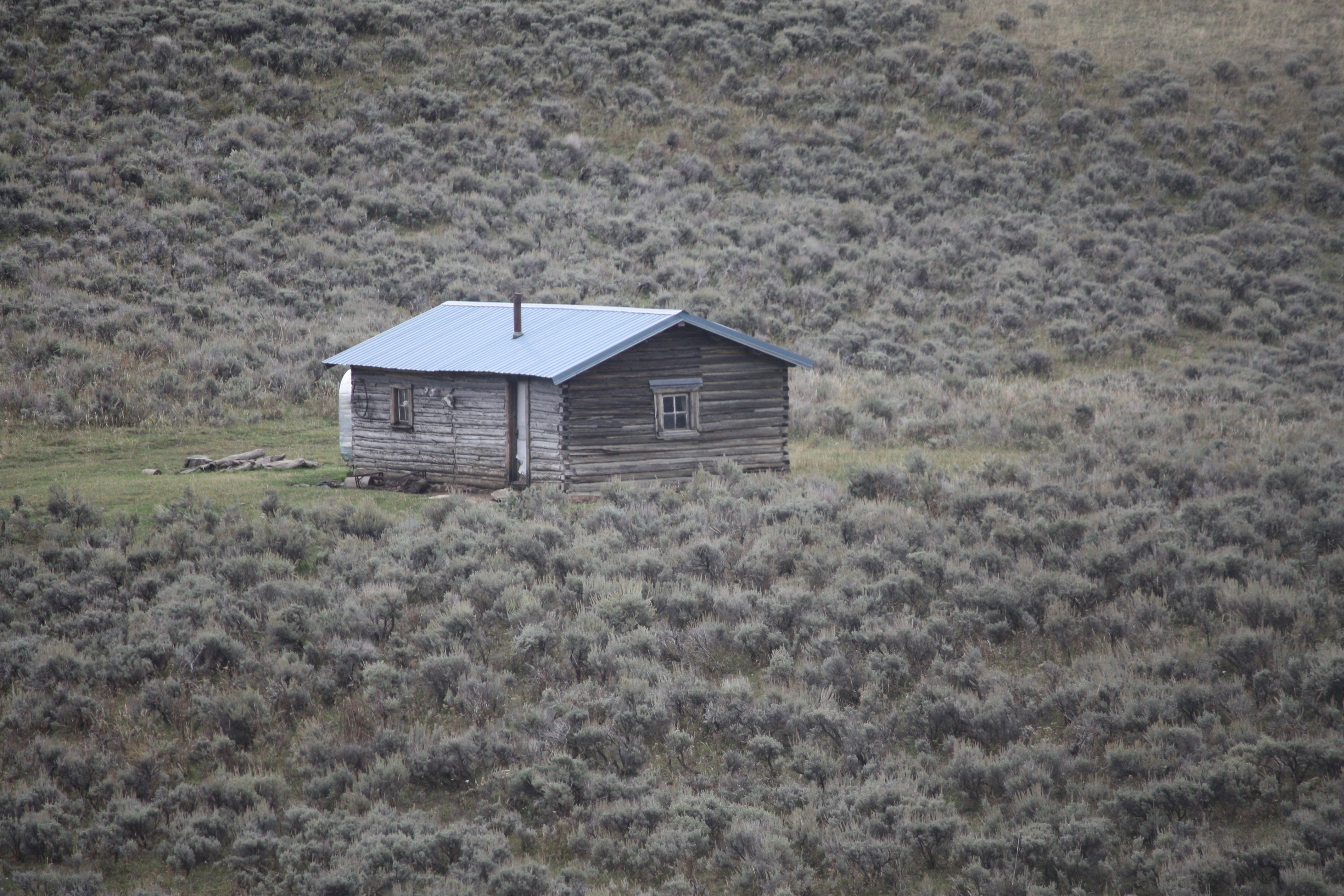
An old camp tender’s cabin is flanked by a more modern version, a camper trailer.  Star filled skies here are quiet except for an occasional coyote.

IMG_4997 (2)

Where sheep may safely graze . . . .

Once the predominant herds on the mountains, sheep are now far fewer in number, replaced by cattle.

IMG_5006 (2)

Clouds . . . .

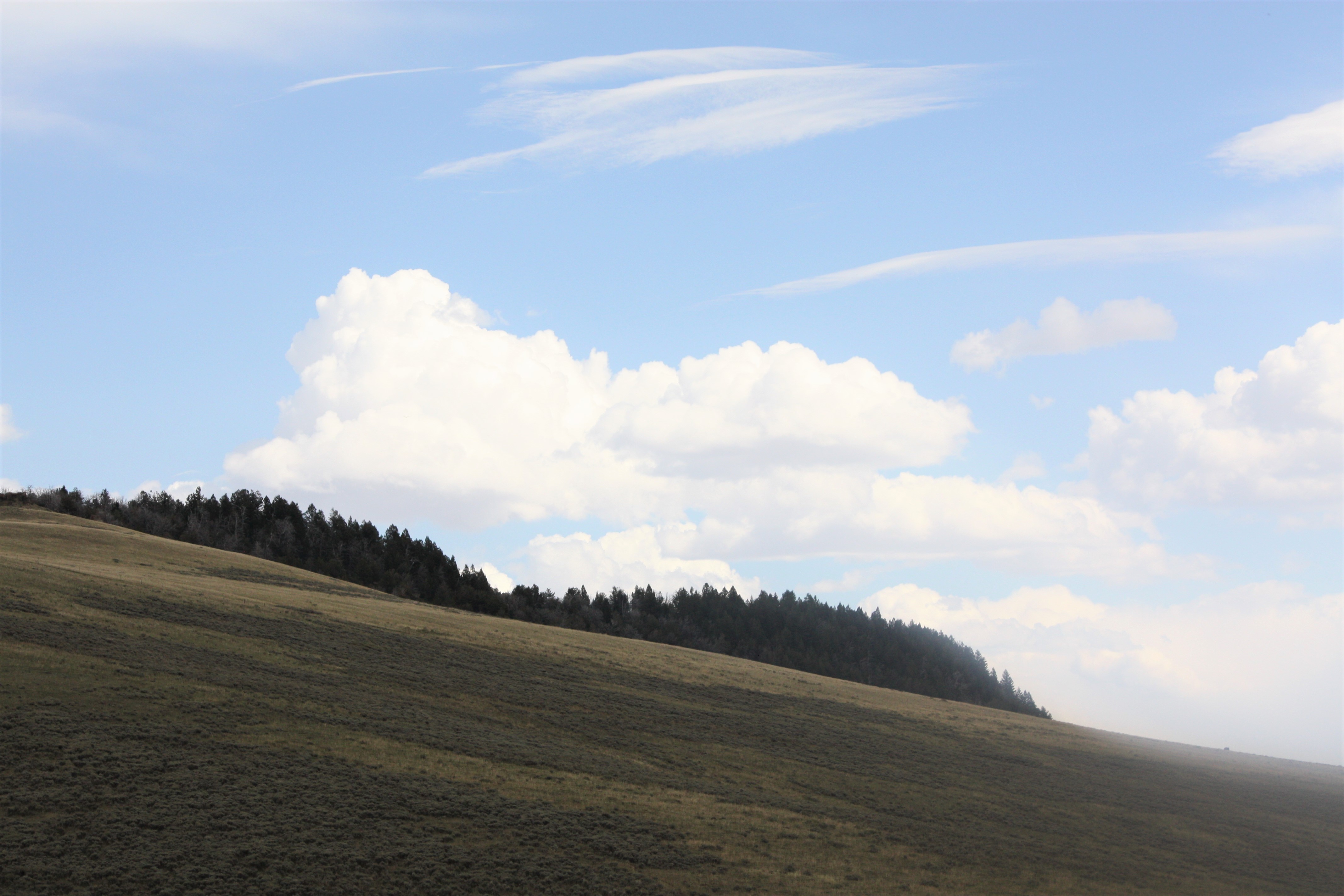
That old refrain, “where the skies are not cloudy all day” could not have been about Wyoming.  The clear blue skies are usually a combination of impressionistic cloud formations that can lure the observer into daydreaming.

IMG_5010 (2)

Fixer-upper . . . .

A more primitive living quarters for the camp tender.  This old sheep wagon has seen better days but serves as a reminder of what life was like before the more modern mobile home or camper trailer arrived on the scene.

IMG_4983 (2)

Prairie chicken . . . .

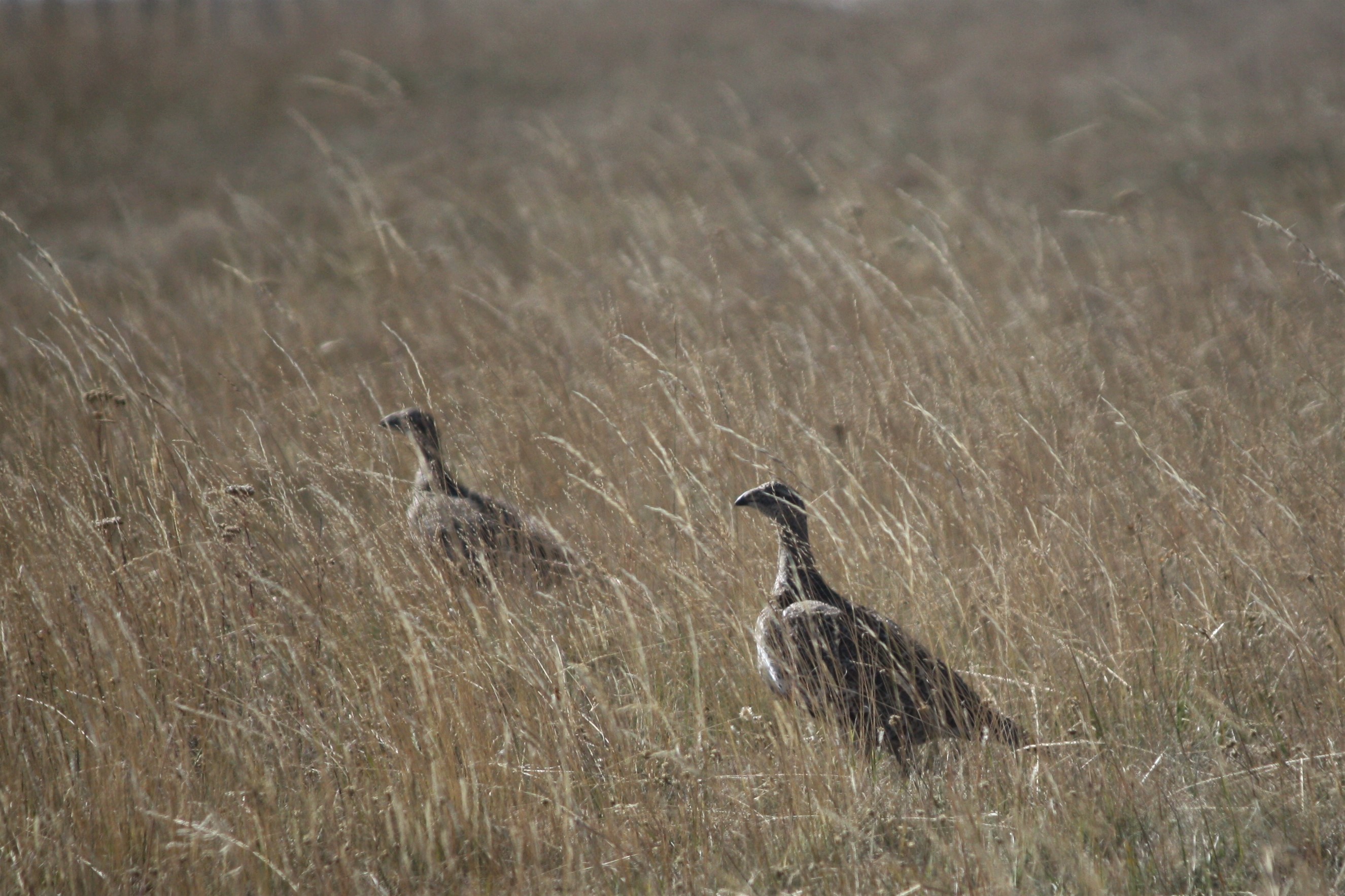
Many parts of the Big Horns are heavily covered with sage, which is where these sage grouse call home.  Wyoming has the greatest population of these birds of any state, and we go to great lengths to preserve them.

IMG_5002

Transportation . . . .

Steep slopes and rugged terrain dictate the terms of transportation.  The horse is still seen as a vital partner in the gathering of sheep and cattle on the mountain.

IMG_5014

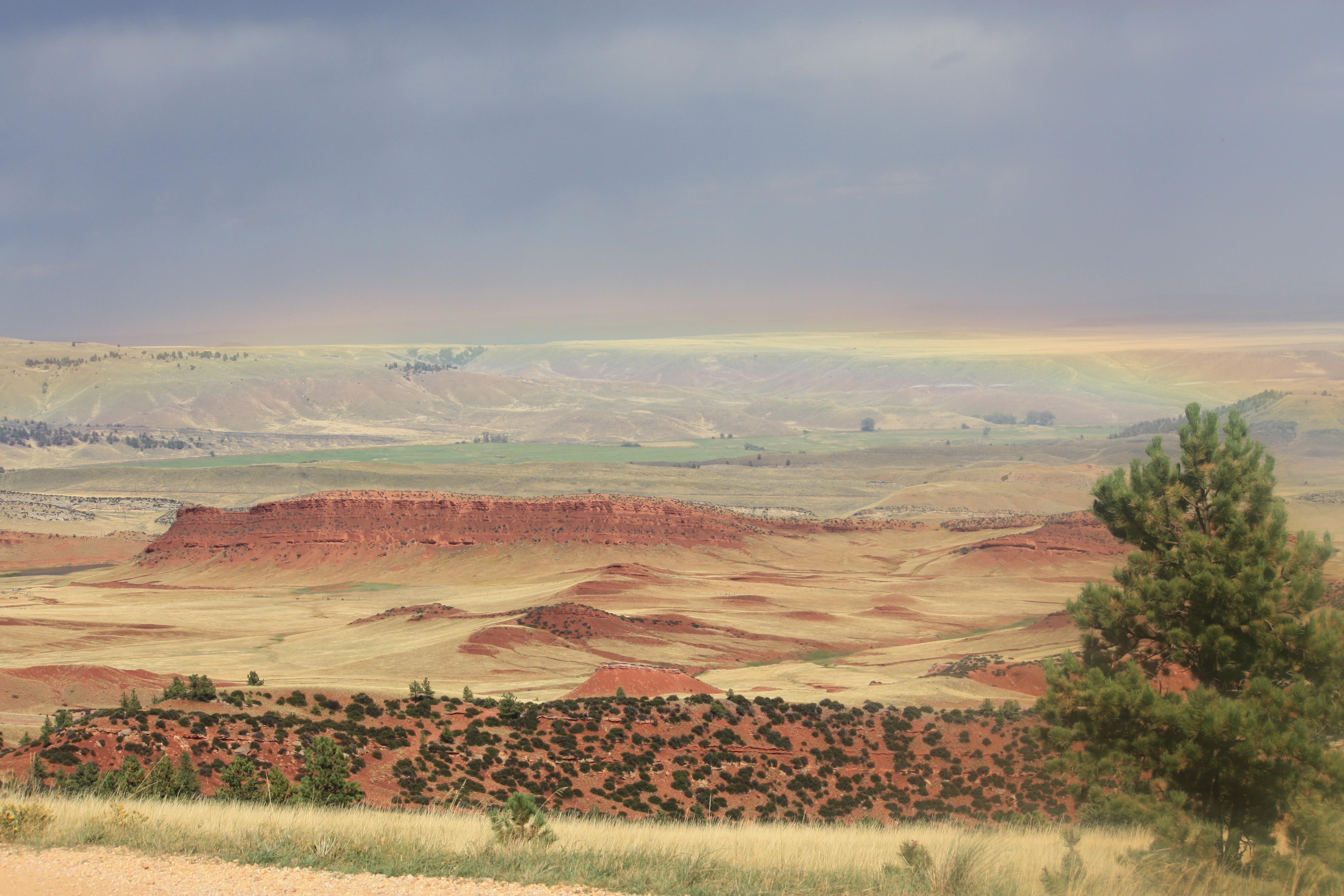
The Red Wall . . . .

The drive down the face of the Big Horns on the Slip Road affords a view of the red wall country and a stop for a cold beer, seated on a flat rock we favor.  The view differs from season to season and due to changes in the weather but is always magnificent.  The grandeur of the open west never ceases to fill me with wonder.  I hope it stays that way.


Drought 2020

IMG_1258 (2)

Not too tasty . . . .

We are suffering from what the “experts” describe as “severe drought.”  The last rains came the end of June, with one inch over a week and nothing since.  We watch each day as clouds build, threaten, and move on.  Scattered thunder storms have brought some relief around us, along with hazardous lightning which starts grass fires that have burned in all directions.  Most recently a fire started just a half mile away and fortunately the highway served as a barrier to keep it from moving toward us.

IMG_1246 (2)

Stunted bunch grass . . . .

Tilly’s paddock will usually support 1-2 horses throughout the summer with grasses so tall and coarse that I try to mow some sections so she will graze the shorter, finer grass.  This summer she is subsisting on hay and while we have creek bottoms with grass up to my chin, she won’t partake when I turn her out.  But that is another story.

IMG_1245

Fuel for fire . . . .

After a very wet early spring (March/April) grass in some areas took off.  Now it stands waiting to burn and is fueling the fires all around.  The volunteer crews working the blazes are nearing exhaustion as they try to put up hay and keep up with the routine operations of managing their ranches.  The more serious fires have required planes to drop fire retardant but persistent winds have made it difficult to put out the flames.  One has to wonder what lies ahead for fall and winter weather.

IMG_1250 (2)

A little shade . . . .

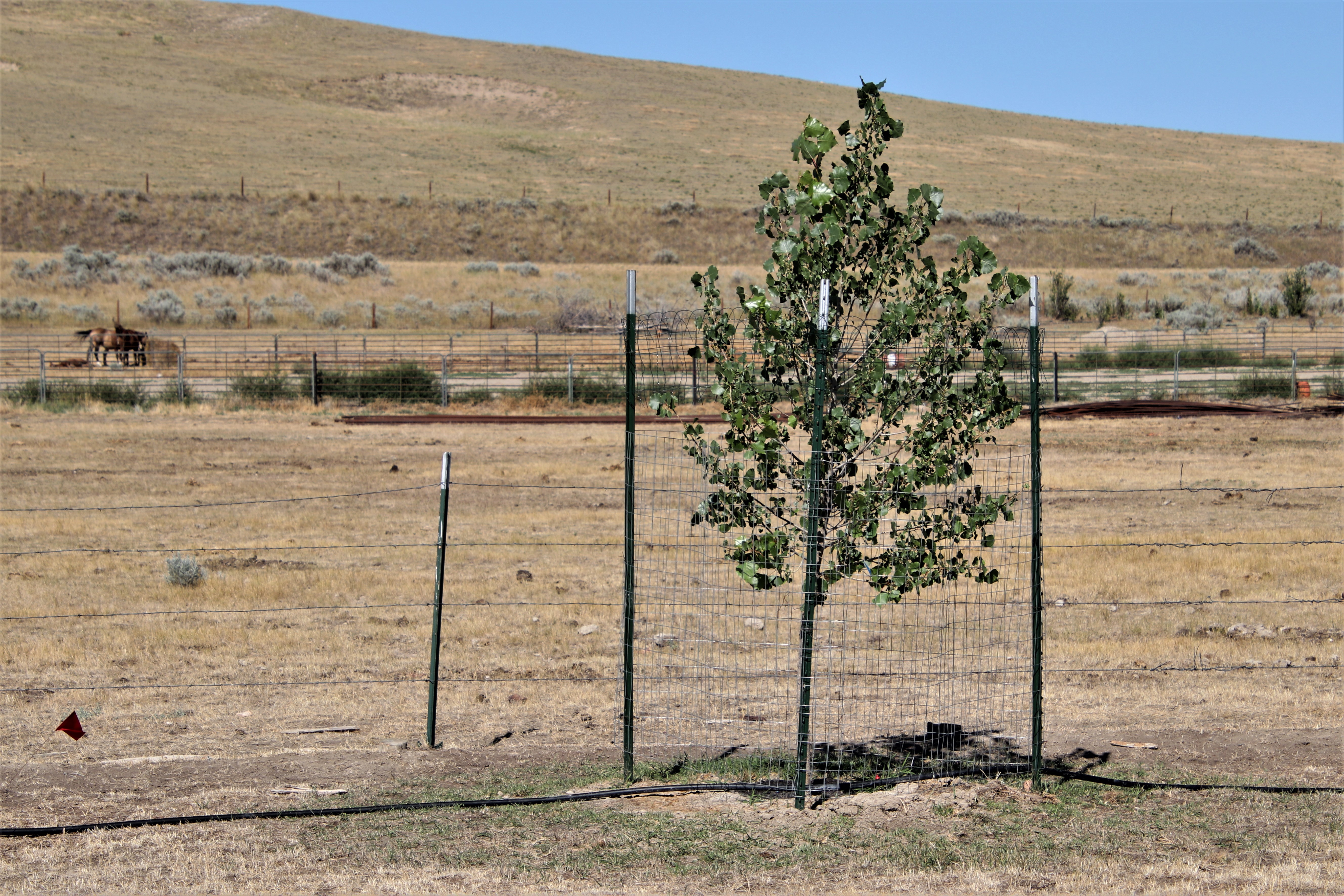
We planted cottonwood trees on the west border of Tilly’s paddock.  These, along with others we have planted, are surviving on drip systems which use very little water and keep the trees alive through the drought.  A fast-growing tree, these will bring shade and shelter in the coming years.

IMG_1242 (2)

Someday a shady lane . . . .

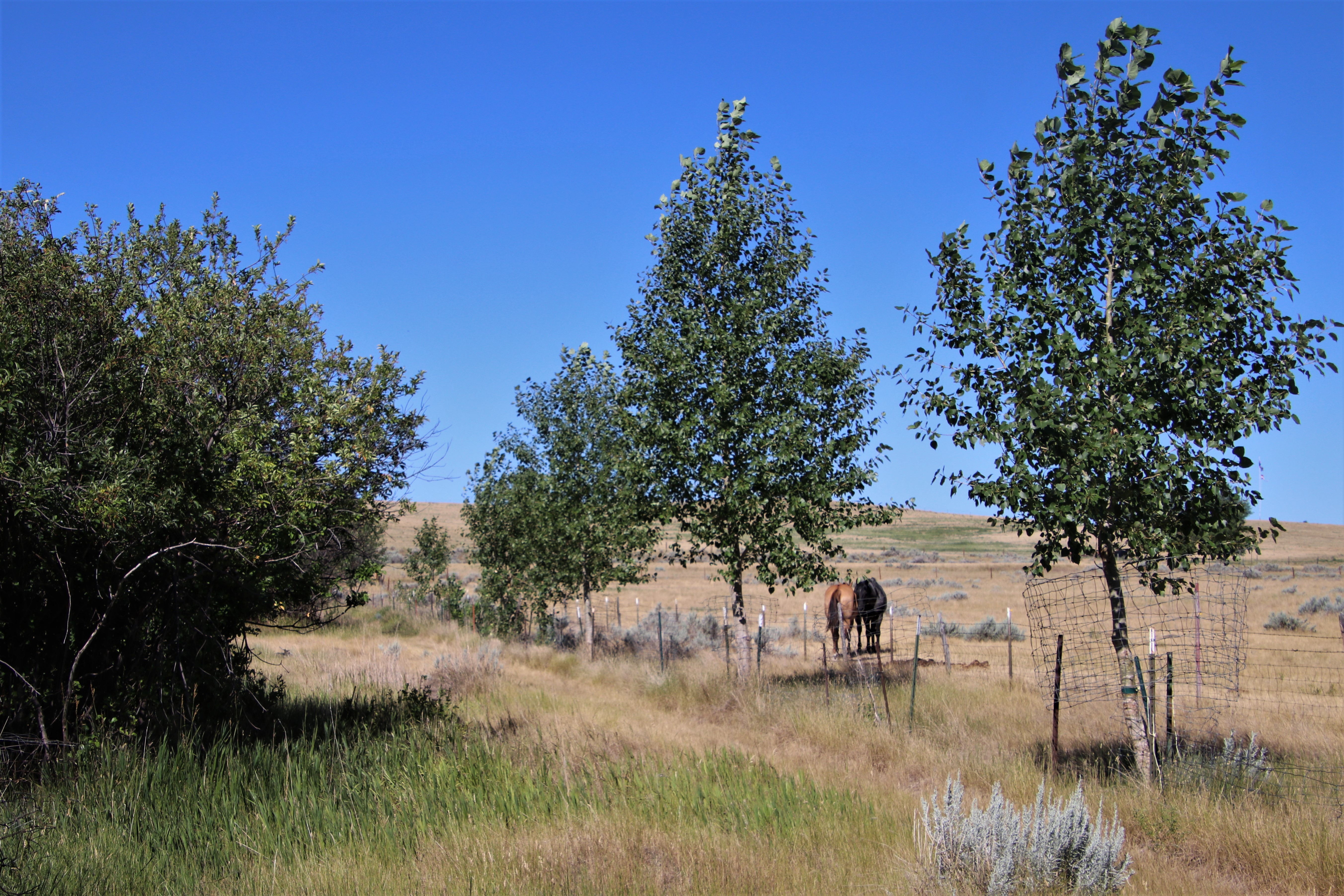
These cottonwood trees (right) were planted several years ago and suffered many disasters: the local deer population eating the leaves and smaller branches; Feed Lot, the longhorn steer tearing up fences and breaking branches just for fun; and grasshoppers stripping them bare, robbing them of nutrients for the winter.  The drip system we installed needs annual maintenance and new emitters because any extended loss of water to these trees in a drought means losing them and starting all over again.  But I won’t give up.  My family began this shelter belt 60 years ago and many trees were lost in dry years.  Russian Olive trees (not pictured) made it through, barely, but they are now quite old and I want to be rid of them.  They are invasive and no longer desirable.

IMG_1241 (2)

Babies . . . .

Twenty new chokecherry trees are slowly putting on growth and will need new fencing to protect them from the deer in spring.  The older chokecherry trees in the background were part of the shelter belt we planted back in the 1960’s but many have died off due to little rain  and too many deer foraging for the new growth each year.  They have been included in the drip system and hopefully will continue to flourish.  Growing trees in Wyoming isn’t for the faint of heart.

IMG_1254

Dry Creek is dry! . . . .

After flooding and then running continuously from February to June 1, Dry Creek has all but dried up.  Lots of flood debris waits to be cleaned up when we can safely get vehicles into the area without sinking in the mud.

IMG_1253

Pond scum . . . .

The last remaining section of the creek that holds water is now ripe with algae and not a very pleasant sight.  It too will likely be dry by the end of August.  Good-bye to the mosquitoes that have plagued us all summer.  That is the only positive development that will come with the current drought.

Spring Things

IMG_0848-001

Time out . . . .

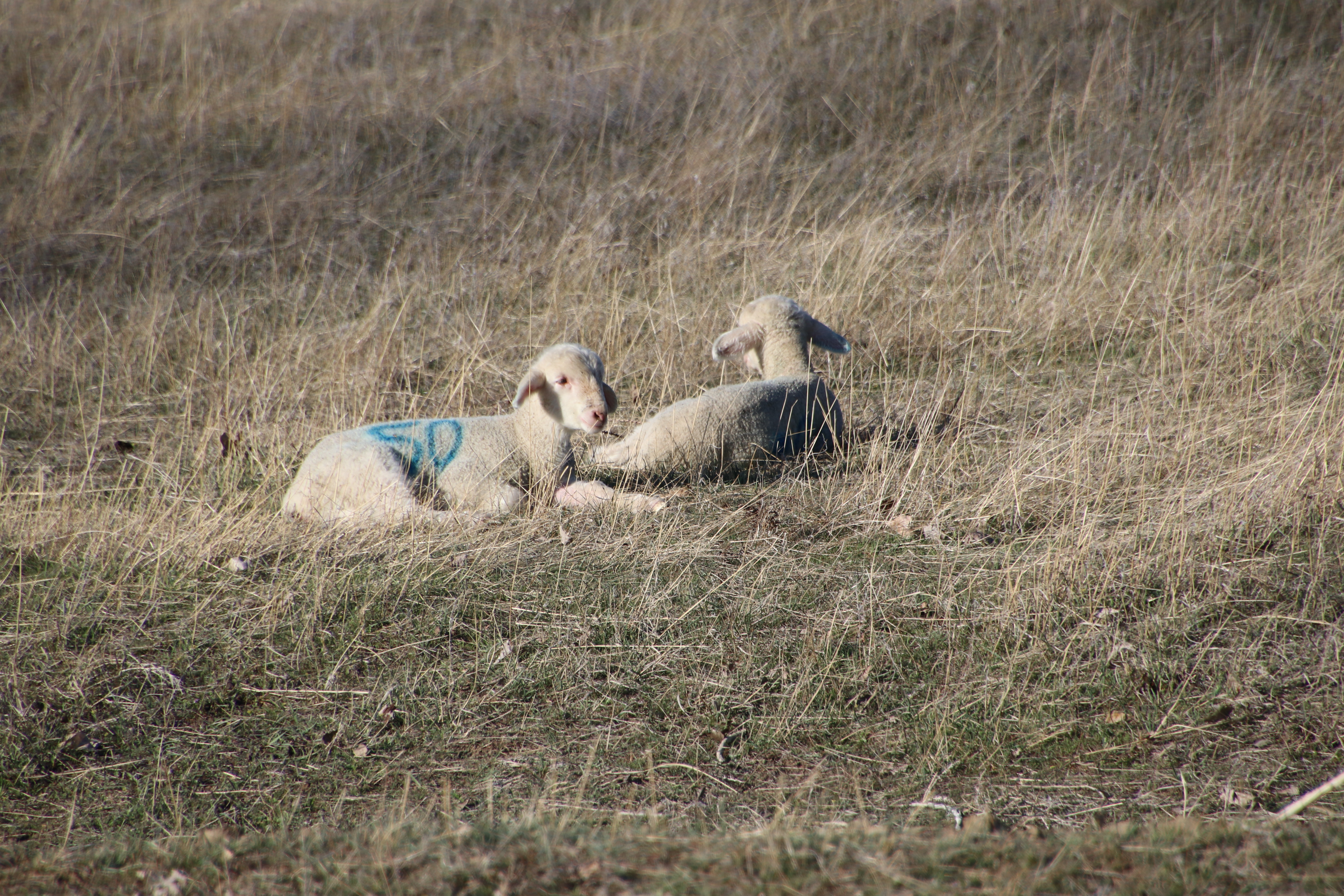
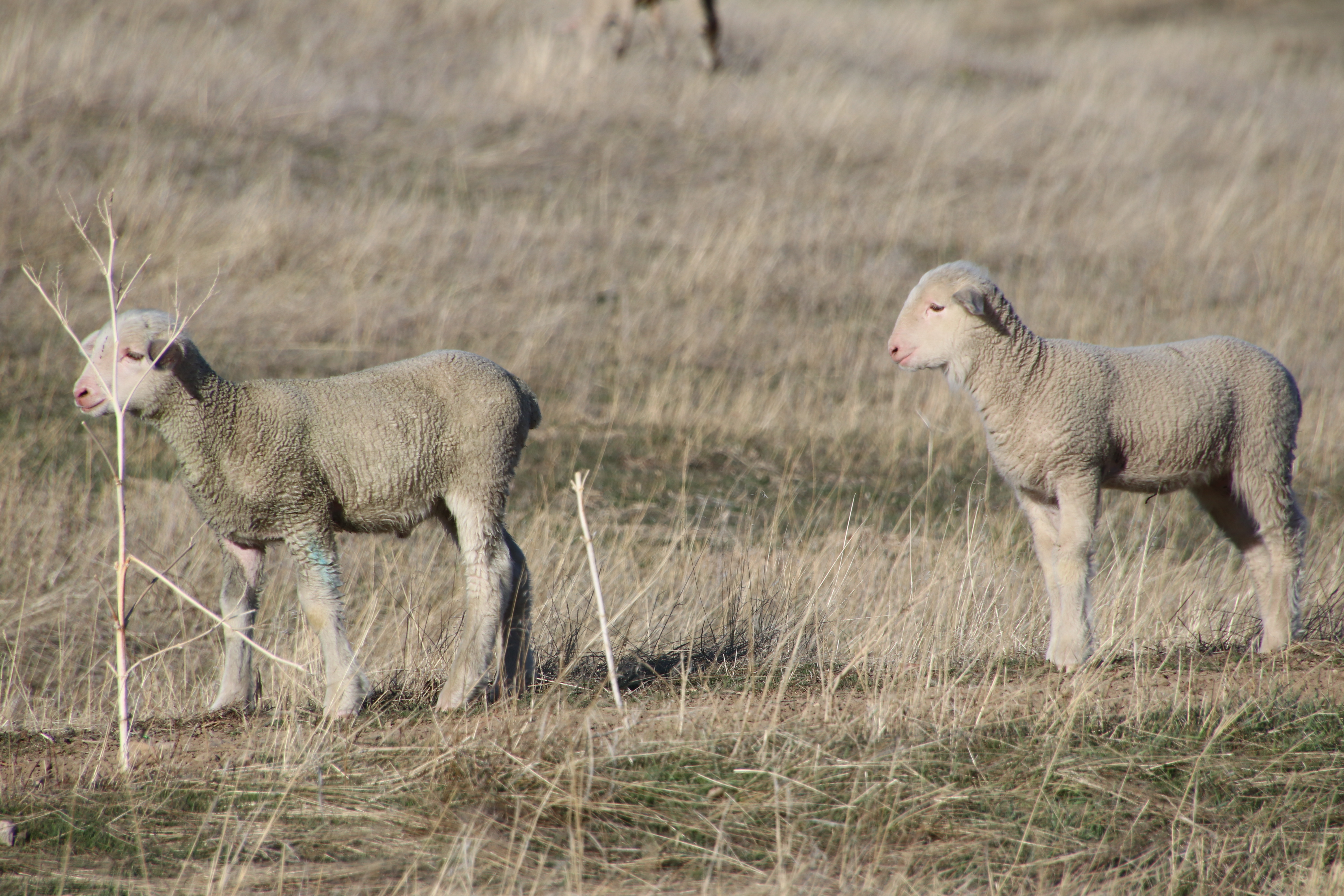
Young lambs take a rest across the fence in our neighbor’s pasture.  It is great fun to watch them and brings back memories of my involvement with sheep as a youth.  Each spring we would end up with a dozen or so “bum” lambs whose mothers refused to nurse them.  We assumed the ewe’s reaction was to having too many if she had triplets, or for a variety of reasons only she knew.

IMG_0844

Where sheep may safely graze . . . .

The survival rate of bum lambs is not great, and my heart was broken over each and every one that died.  We fed them with soda bottles with a specific black rubber nipple attached.  We mixed up their feed from a powder mixed with water that was formulated for infant lambs and they were always so eager to suckle.  As they grew, they would jump up and practically knock me off my feet trying to reach the bottles I held.   Their little hooves were sharp and left a mark.

IMG_0847-001

Looking for mischief . . . .

On mild spring evenings I would let the lambs out of their pen and take a walk with them.  They would follow closely behind, stopping to nibble green grass and ramble around.  I am certain they were so happy to be out of their pen to explore and play, which was hilarious to watch.  Similar to young goats, they love to frolic, leap and jump in the air, calling out to one another.

IMG_0833-001

Time to grow . . . .

Getting a jump on the garden requires a strategic early start as the growing season here is very short.  Inside this tent is lettuce, kale and spinach, cool weather crops that will mature early in the season in time for another planting.  Spring is our busiest time of year and gardening requires a major commitment and chunk of time if we are to be successful.

IMG_0883

Tucked in the rocks . . . .

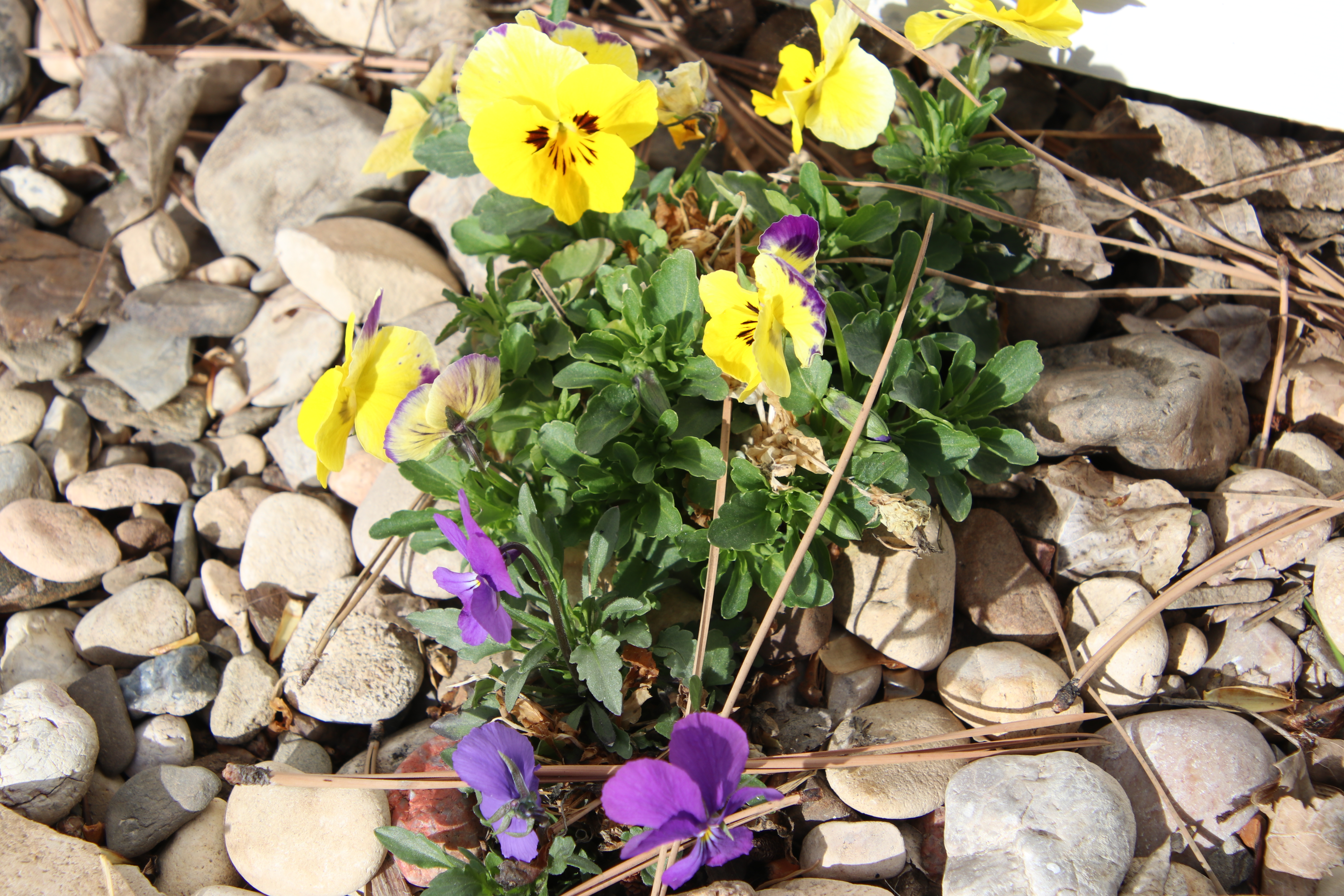
Volunteer pansies peep out from a rock-lined path on the east end of the house.  They arrive early to remind me that they are tough enough to endure our spring weather, which means they will likely see snow and frost into June.  I recently planted a couple of flats of pansies in large pots around the house, confident that my volunteers know what they are doing and I will follow suit.

IMG_0857

On duty . . . .

Great Horned Owls live in the cottonwoods in the creek bottom and each spring they keep a vigil in the tree tops. Beginning in January nesting pairs will begin to serenade each other in a lovely duet each evening, with the male uttering five or six resonant hoots: Hoo!, hu-hu-hu,Hoo!Hoo!  The females’ hoots are shorter in sequence and may just be a single Hoo!  In March and April one owl can usually be heard singing softly in the early morning, and in May the piercing “scrawk” of baby owls can be heard overhead.  If all goes well, the young owls will fledge by the end of May and move away from the nest.

IMG_0843

First grass . . . .

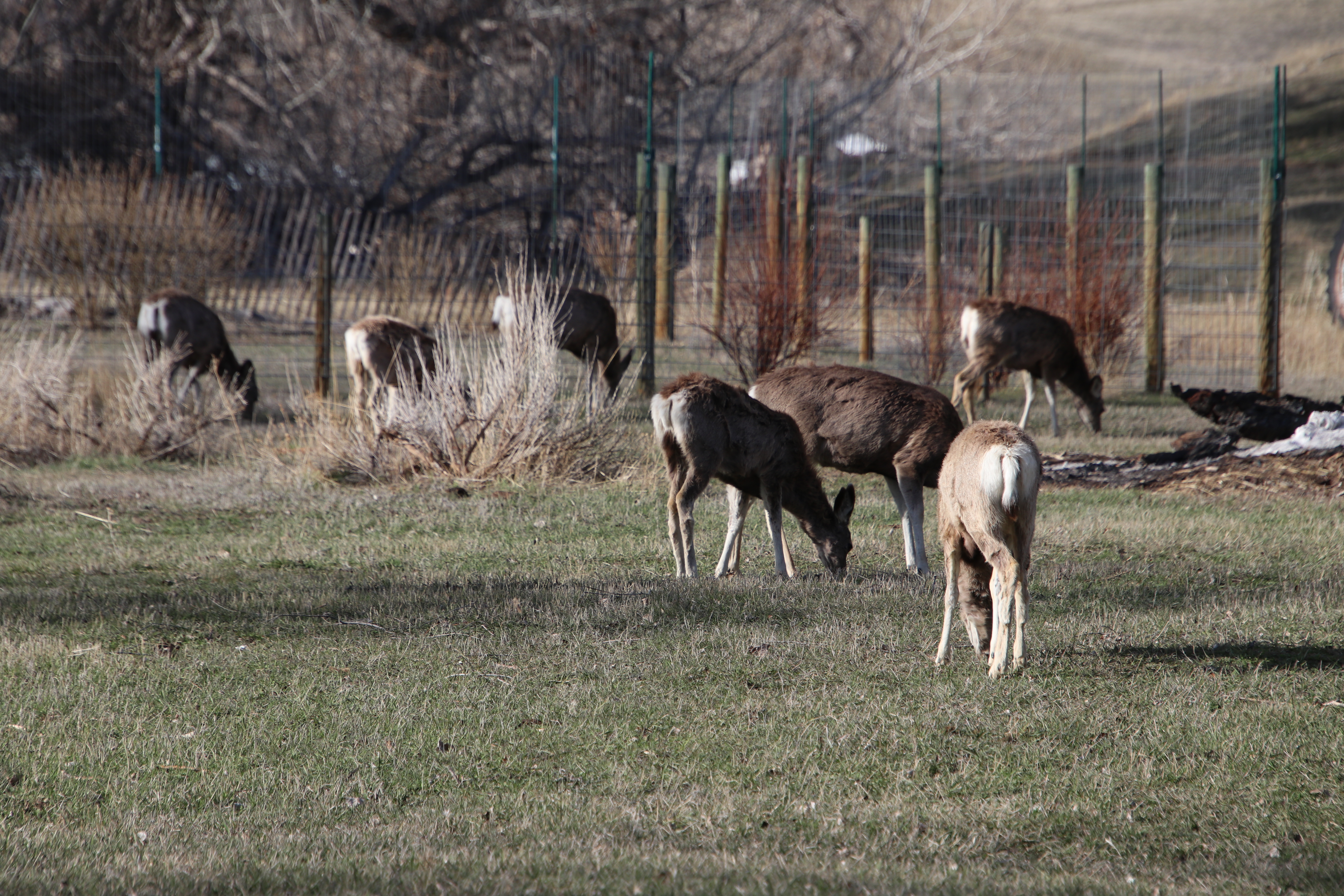
A group of does and yearling fawns hang around the yard checking out the forage.  Before long the does will hide in the sage and pockets of scrub in the area to have their fawns and we won’t see them for awhile.  The yearling fawns will appear a little disoriented and scatter about, looking for a new connection while the does give birth. I love seeing the baby fawns when they come out of hiding.

IMG_0862-001

“What’s for lunch?” . . . .

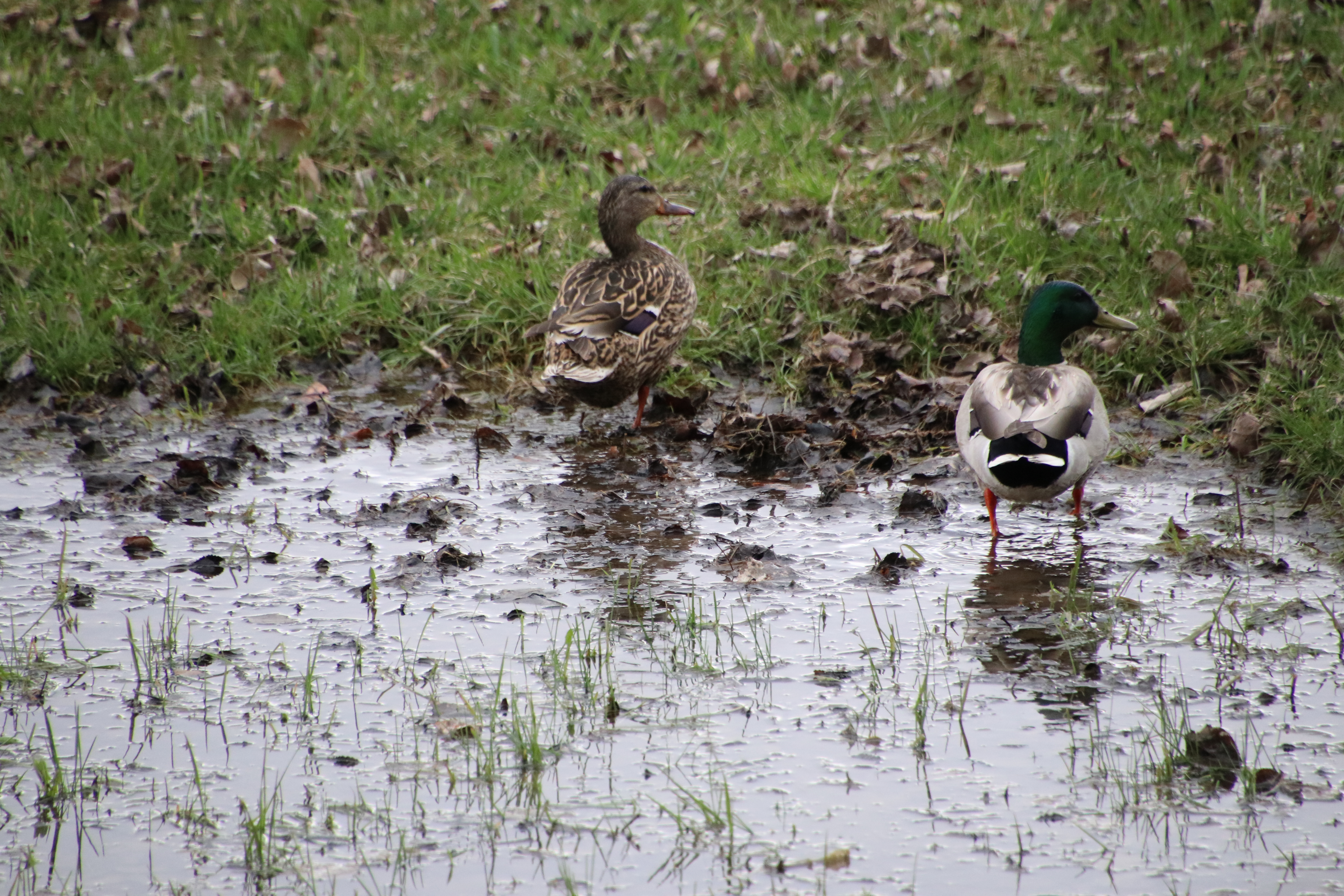
A pair of Mallard ducks have adopted the pond that has formed in the creek bottom.  They appear each day to swim and browse, and we believe they have a nest nearby.  Spring brings forth new growth, new life and new expectations.


Minnie Pearl, Guinea Hen

IMG_0534

Just a lonely girl. . . .

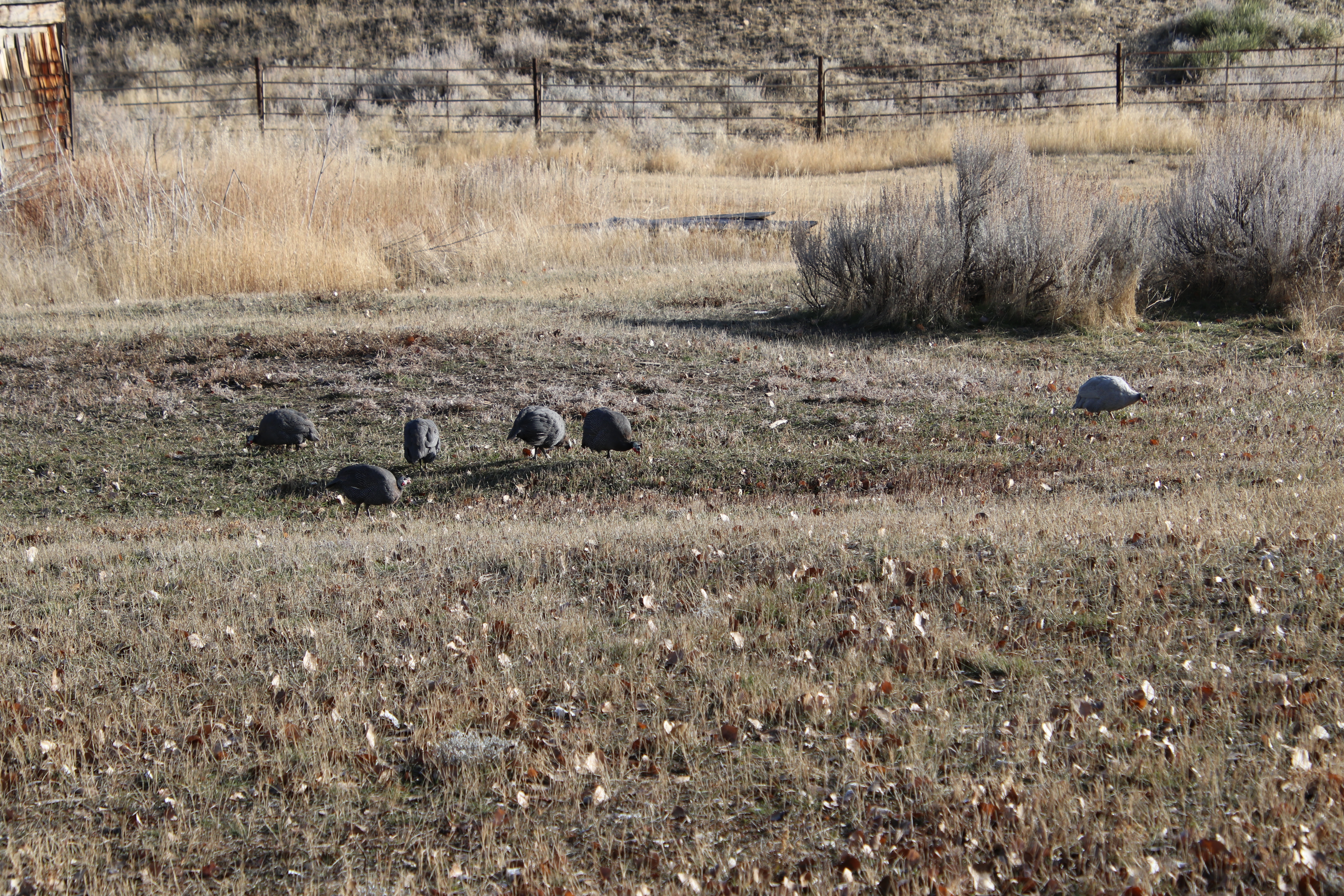
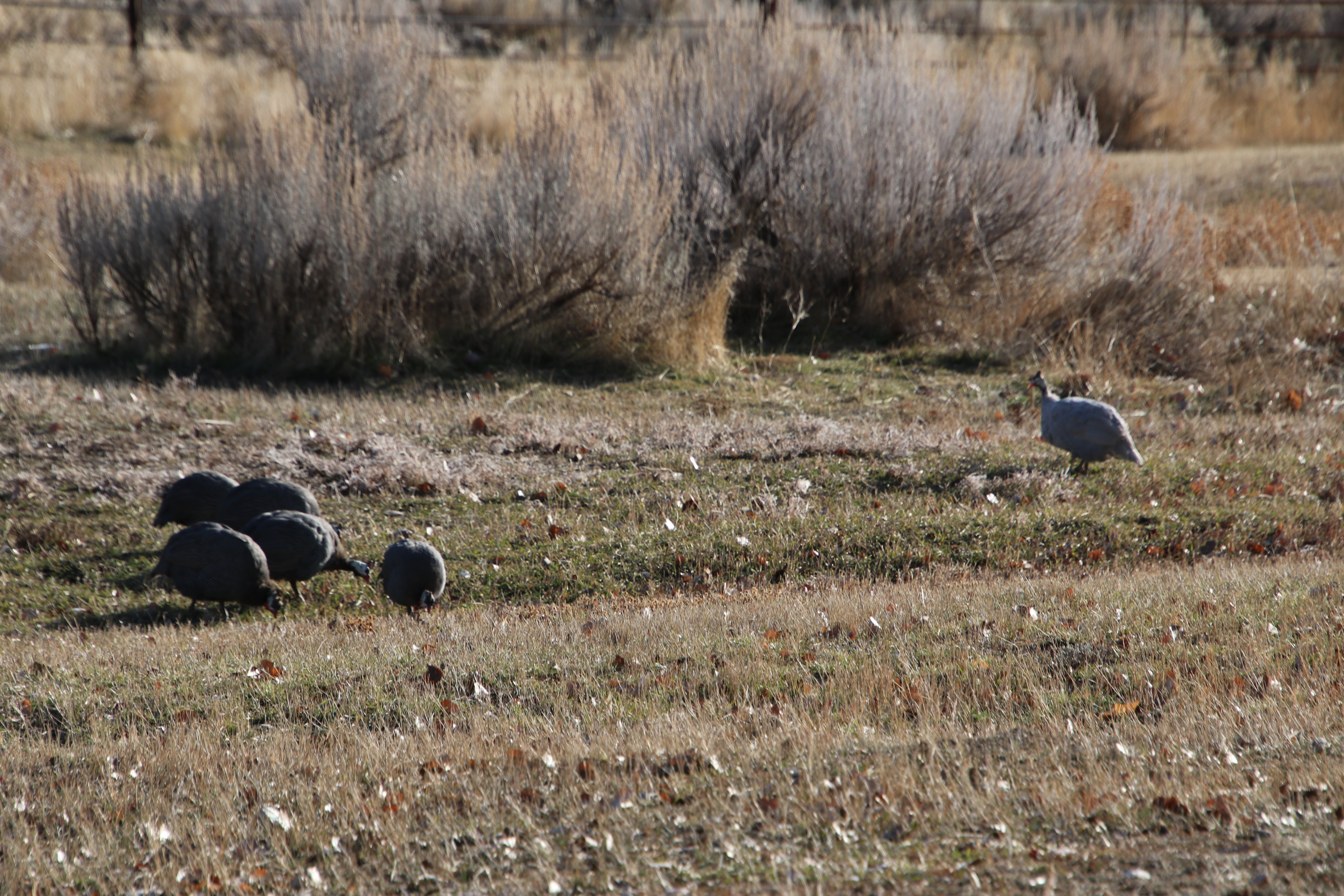
The numbers of our guinea flock have fluctuated over the years from an over-abundance to so few we worried we might eventually not have any due to attrition.  A neighbor who had successfully raised too many little keets called late last fall to see if I would be interested in adding to our dwindling flock of five adult guineas.  I agreed to take six young ones from her, including four of the pearl, or light colored ones.

IMG_0535

A bug-eater . . . .

Guineas are different from chickens in that they don’t bond with newcomers to their flock.  This is a lesson we had heard from others, but learned first-hand with our six new guineas.  Once placed in the “big house” with the other chickens and mature guineas, the little ones were ostracized and pushed aside.  Attrition began to occur at an alarming rate and over a few months, we were left with one young guinea who I named Minnie Pearl.

IMG_0549

Keeping her distance . . . .

Guineas love to graze far and wide and Minnie Pearl tried to stay on the fringe of the group hoping to be accepted.  She was always by herself in a corner of the poultry house when I came in to feed and gather eggs, and she did not roost with the rest of the chickens or guineas at night.  We believed that over time she would fit in with the older group but over the winter months it became evident that she was still an outcast.  On several occasions I observed one or two of the older guineas picking on her.  Was it just her pale color they did not accept?

IMG_0548

So near yet so far . . . .

A few weeks ago there was a fracas out in front of the poultry house that ended up with Minnie Pearl on the roof.  She had flown up to escape her tormentors and would not come down.  It was bitter cold and snowy and the metal roof offered little protection.  Toward evening it was apparent Minnie Pearl intended to stay where she was.  We reasoned that if we tried to get her down she would likely fly into the nearby poplar or elm trees, which would leave her equally as exposed to the cold.  As darkness descended I decided to try one last time to coax her down.  I went out with a broom and aimed the brush end at her.  I let fly several times, getting closer with each throw but not close enough to dislodge her.  Finally my broom stayed on the roof, leaving me frustrated.

IMG_0532

Her mind was made up . . . .

I gave up and headed through the gate when I noticed a large tree branch about 4 foot long and an inch in diameter sticking up from a snow bank.  By now it was almost dark and I was determined to try once more to get Minnie Pearl down from her icy perch.  I pulled the branch out of the snow, backed away from the poultry house far enough to get a good sight-line of her, and hurled the branch as hard as I could, hoping I would not hurt her.  WHAACK!!!  I nailed her and down she fell on the opposite side of the poultry house, into the yard.  Maud the wonder dog was all over it and chased her under a spruce tree, where she lay paralyzed with fear.  I made it through the gate as fast as I could run in the snow, sighted her huddled under the lower branches of the tree, and grabbed her in my arms. She was cold and shaking and I ran to the house with her.

Michael retrieved a cat carrier from the garden shed and we placed her on a towel inside and locked her in.  She spent the night in the bathroom in front of the heater. Next day I called a friend who also raises chickens and pleaded with her to add Minnie Pearl to her flock.  I could not bring myself to put her back into the hostile environment that she had endured in our poultry house with the older guineas.  Our request was graciously received and Michael loaded Minnie Pearl up and delivered her to Joyce, who has been caring for her since.  We are grateful that her chickens don’t mind, and that she took pity on one of God’s little creatures.  Minnie Pearl is thriving in her new home and roosts with the chickens at night.


A Winter’s Tail

IMG_0706

Pete the Wandering Peacock

A male peacock which belongs to a neighbor is perched up in the cottonwood tree and on this particular day, we are having a winter storm complete with wind, drifting snow and all around misery for our feathered friends.  I was headed to the barn to care for Tilly, our mare and Feed Lot, our Long Horn steer when I got a tug from Maud’s leash.

IMG_9416

Maud, Wonder Dog

At 50+ pounds, when Maud decides on a direction she is hard to resist.  More often than not, she drags me along or worse yet, pulls me off my feet in a mad dash for a deer, rabbit or some other imagined chase.  On this day, she sighted the peacock up in the tree and wanted to investigate. We have been watching and caring for the peacock for about a month in the hopes he will head home on his own volition.  He evades capture so we are left with few options.  It seemed odd he would be up high in a tree in a storm.  A feeding bowl at the base of the tree had blown full of drifting snow.  I planned to check on it when I came back from the barn, but with Maud’s insistence, decided to dig it out and re-fill it in case a frozen bird needed a bite of sustenance and could not wait.

IMG_0577

Still snowing . . .

We walked back to the garden shed where the bird feed is kept, filled a small bucket with seed for the peacock, and before I could open the gate to leave , there was another tug on the leash.  Since we were still in the yard, I let go to see what Maud was so interested in.  She raced to the fence nearest the chicken house and barked ferociously.  The snow was blowing and swirling so hard I would have overlooked two of my favorite Welsummer chickens huddled and half frozen by the chicken house door.  These hens wander up and down the creek bottom foraging until the other chickens have gone in for the day.  I had overlooked them and locked up leaving them out in the storm all night.  Poor girls, I had to pick them up and carry them inside to warm up.

IMG_9402

Maud knows best . . .

Meanwhile, there is still a very hungry peacock perched high up in a cottonwood with the wind and snow swirling around him.  I dumped the bucket of seed in the bowl where I have been feeding him and kicked the snow back in the hope it would not drift over before the peacock decided to come down and have a bite.  I have been feeding him at two locations, but the snow is badly drifted up along the grove of Russian Olive trees that he travels back and forth between.  I doubt he’ll be doing much travel today and my worry is that he will suffer frostbite if he doesn’t come down soon.

Day II – Minus 3 degrees last night, storm and winds died down and today it is sunny.  Pete the peacock is still in the tree where we believe he has been ensconced for about 36 hours now.  He is still alive, perhaps he can no longer fly down?  I expected to see a frozen, dead bird on the ground this morning, but he is still hanging on.

IMG_0758

“Where’s lunch?” . . . .

An update is in order.  Pete’s travails are no less than temperatures that have dipped to -21 degrees, combined with several additional snow storms, and he is still managing to stay alive.  Taken Feb. 22, this photo captured him near one of his feeding stations at the base of some Russian Olive trees.  We were traveling for several days and wondered how he would manage without his daily rations.  Fortunately for Pete, our animal caregiver took pity on him and dumped some wild bird seed for him.

IMG_0766

“Where’s lunch?” . . . .

As if Pete didn’t have enough trouble, a herd of deer that hang around all winter have discovered his feeding bowl and scooped up most of the cracked corn and sunflower seeds, leaving Pete with the crumbs.  What is a guy to do?